EventMag (EM): Nikita, thank you for joining us. You highlighted that the industry is changing and the audience is evolving. Why do event professionals need to focus on implementing “new mechanisms” right now to influence audience presence?
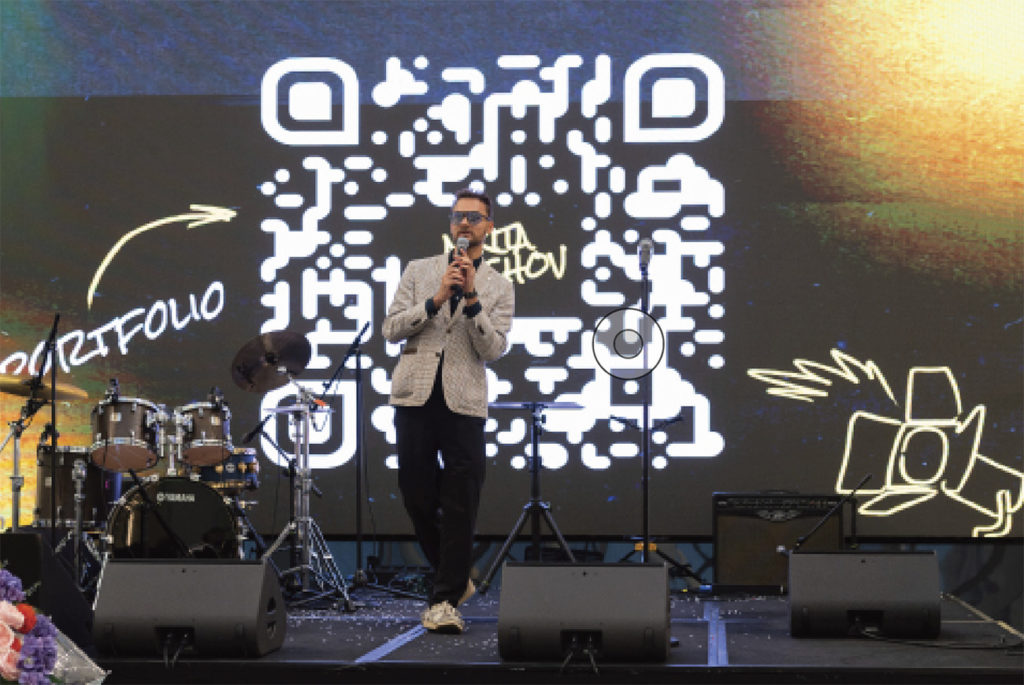
Nikita Menshov (NM): Thank you. That’s absolutely right. The audience is evolving, and therefore we need some new mechanisms to be able to influence their presence. If you look around, sometimes the energy is just very low. My presentation was dedicated to helping people understand how they can elevate that energy, whether they are running a conference, a big event, or a small event.
EM: You started your talk by having the audience estimate their current energy level on a scale of 1 to 10. What is the importance of first assessing, and then actively raising, the energy in a room?
NM: When I started, judging by what the audience was doing, I believed the energy was very low. Assessing the energy (where 1 is wanting to sleep and 10 is wanting to jump and dance) provides a starting point. The goal is to see if we can elevate that energy up.
I teach tricks on how you can elevate the energy of your audience. For example, the exercise we did involving counting up to three, then taking away numbers and replacing them with actions—like clapping instead of ‘one,’ standing up instead of ‘three,’ and making a noise instead of ‘two’—is a simple, yet highly effective way to achieve this.
EM: These exercises involve a lot of physical and mental engagement. What is the psychological theory behind why these “stupid” activities build trust and connection?
NM: That’s the magic! Many people try to make the audience jump, but the audience often thinks, “Why am I doing this?” and that’s not really engaging. What we did was more than just focusing the audience; they became more energized.
The reason trust and connection increase is because we did something together. There was a shared experience. When you clap or jump or make a noise with me, and I participate at the same level as you, we share that experience. Psychologically, you become more connected to me than you were before.
EM: Your background is in improvisation. How does your experience with improv inform your approach to audience psychology and engagement?
NM: My background is improvisation. Improv is something that truly brings people together. Because they have this shared experience, people tend to open up more, be more focused, more connected, and more “live”. Even if an audience seems diverse and not everybody is engaged, I can still manage to take the focus I need and make it work.
EM: For event organizers who might lose connection with their audience mid-event, what two concrete things do you recommend they do to reconnect and maintain confidence?
NM: I recommend two things.
First: If you feel you have disconnected from the audience, it is okay to ask them. It is okay to make eye contact and play a little game—like the counting game, or asking those initial rapid-fire questions about names or favorite colors—to make them understand that you are here for them. If that works, you immediately feel more connected psychologically.
Second: Take an improv class or an acting class. Give it a go. Every time you are in a situation where you are not aware of how to react or what to respond, or you feel you lost the connection, this training helps you feel calm inside, confident inside, and connected with the audience.
EM: Beyond your work as an MC and actor, you are the frontman of your own acting school in Dubai. What is the focus of your teaching experience today?
NM: My teaching experience is mostly focused on English for corporate works and for huge companies. I also run courses for Russian-speaking people. My core philosophy is about helping people get the different images and characters they have inside out, so they can be more connected with the audience they are speaking to.
Staying connected is key.