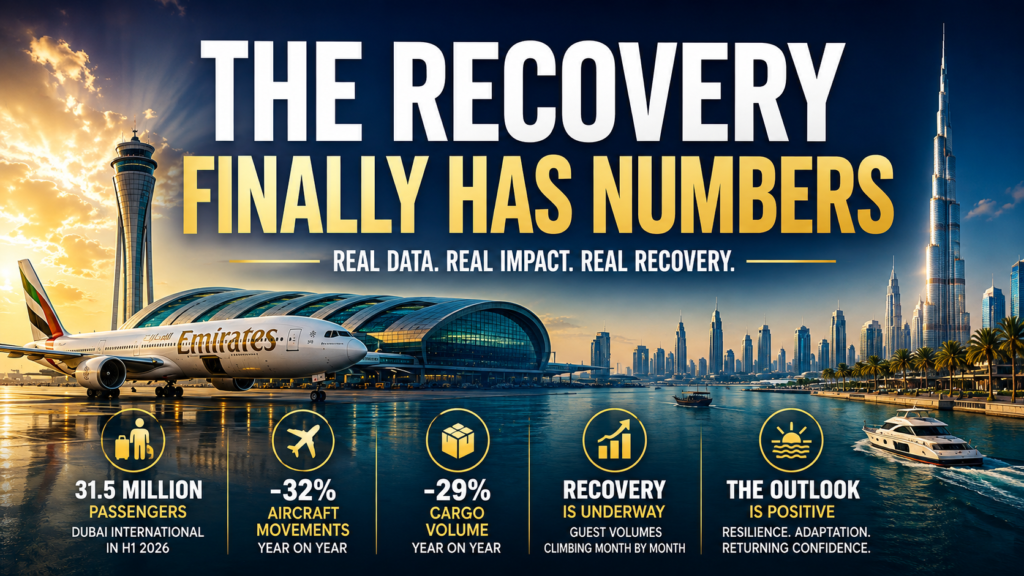

For months this digest has tracked promises: stimulus packages, insurance products, new visa categories, all pitched as answers to a war whose end date nobody could name. This period is different. For the first time, hard first-half data landed – airport statistics, hotel occupancy splits, a new regulatory cost, a stalled sports venture – giving actual shape to both the damage and the response. The timing is worth flagging once: the 14-point ceasefire memorandum underpinning several of these forecasts expired on 17 August, with strikes resuming before the month was out, so read the recovery percentages below as a snapshot, not a trend line guaranteed to hold.
The damage, finally, in one number
Dubai International handled 31.5 million passengers in the first half of 2026, Dubai Airports’ own results show, with aircraft movements down 32% year on year and cargo down 29%. The path through the wreckage is visible month by month: guest volumes climbed from 3.5 million in April to 4.5 million in May and 5 million in June as schedules were restored. Marriott, Hilton and Hyatt all cited the war for double-digit RevPAR declines in the Middle East in the second quarter; Accor’s UAE business was down roughly 80% year on year in April, narrowing to a 40-45% decline by June. “This was a temporary aviation and confidence-led disruption, not a demand collapse,” HVS’s Hala Matar Choufany told AGBI – a distinction the airport’s own numbers now support with a trend line rather than a guess.
The recovery has a shape, and it isn’t the shape anyone expected
Khaleej Times canvassed travel executives this week and found a recovery led not by the international long-haul traveller but by the region itself: leisure and visiting-friends-and-relatives travel is tracking at roughly 85% of pre-conflict levels, according to musafir.com, with business travel at around 70%. Salalah tops the list for intra-GCC leisure trips; Riyadh dominates business travel between Gulf countries. Cavendish Maxwell’s numbers give the UAE side of that picture: Dubai occupancy fell 30.3% across the first half, with a recovery to 60-66% projected over the next four months.
Saudi Arabia keeps building through the numbers, not around them
Red Sea Global opened the 110-key Rosewood Amaala this month – solar-powered, 40 hectares, the third Amaala resort to open this year after the Four Seasons in June and Six Senses in July. The giga-project’s full build-out targets nearly 4,000 rooms and an estimated $3bn contribution to the Saudi economy, and none of the three 2026 openings were delayed by the conflict that WTTC estimates has cost Middle East tourism $600m a day. The contrast with the Gulf-wide occupancy data is deliberate: Saudi’s domestic and religious-travel base has functioned as a shock absorber that Dubai’s more internationally weighted model doesn’t have.
A new line item lands on every venue’s budget
The UAE’s Ministry of Economy and Tourism used the same weeks to introduce something with nothing to do with the war: a formal music-licensing regime, effective 1 December, covering restaurants, hotels, malls and – explicitly – concerts and comparable commercial events. Fees run from roughly Dh1,500 for a small café to Dh50,000 for a large mall, collected through two licensed bodies, the Emirates Music Rights Association and Music Nation, with 10% ring-fenced for a new Cultural Support Fund for Music. For any organiser running a ticketed event with a soundtrack, licensed or DJ-driven, this is a new, quantifiable cost of doing business in the UAE from December – unrelated to the conflict, but landing in the same operating environment.
Not every Gulf sports bet survives contact with its own budget
A smaller, sharper counter-note: LIV Golf cut staff this month as funding from the Public Investment Fund comes to an end – a reminder that not every PIF-backed sports and entertainment venture is scaling regardless of conditions. Set against Saudi Arabia’s continued resort openings and events-infrastructure investment elsewhere, it’s a useful correction to any narrative that reads every Gulf sports and entertainment bet as automatically expanding.
None of the numbers above are wrong. They’re a genuine, first-time-this-detailed picture of where the region actually stands, sector by sector. But they were compiled against a ceasefire framework that has since lapsed, which means every recovery percentage in this issue should be read as conditional – accurate for the weeks it describes, not a promise about the weeks ahead.
Sources
https://www.agbi.com/tourism/2026/08/war-cuts-dubai-airport-passenger-traffic-by-nearly-a-third/
https://www.agbi.com/tourism/2026/08/saudi-arabia-opens-new-red-sea-resort-despite-tourism-downturn/
https://www.agbi.com/business-of-sport/2026/08/liv-golf-cuts-workforce-with-pif-funding-ending/