



On 6 October, Bahrain opened the first Made in GCC Forum and Exhibition on schedule, with the Crown Prince in the hall. The same week, missiles hit airports in Abha and Riyadh, hundreds of flights out of Saudi Arabia were cancelled, and Lufthansa Group suspended Riyadh service through 16 October. By Friday, Saudi aviation authorities said operations were back to normal.
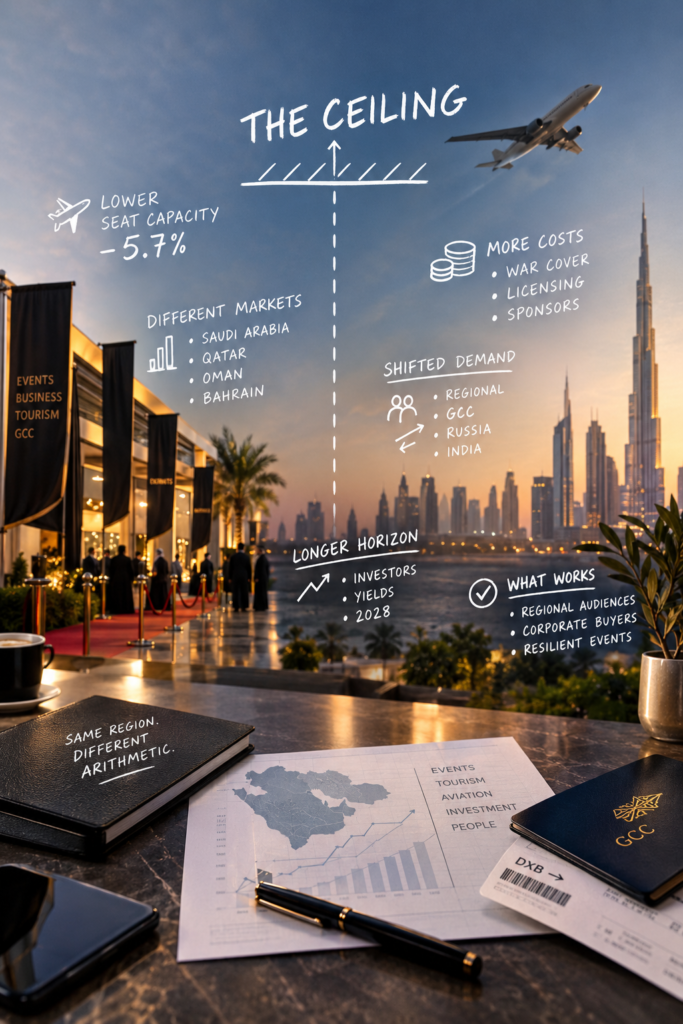
Nothing about that week was normal. Everything about it was workable. That is the new condition of the market: not recovery, not crisis, but operation under a ceiling.
The ceiling is overhead
October flight schedules put Middle East seat capacity 5.7% below last year, according to OAG, or 2.2 million fewer seats. The UAE, the region’s biggest market, is down 9.5%. In mid-September Emirates told The National it was flying about 95% of its February capacity and expected prewar levels by year-end. The Q3 forecast from STR and Tourism Economics states the practical consequence plainly: summer came in stronger than expected, yet the fourth quarter was not upgraded, because international inbound demand stays depressed until carriers return, a return it assumes by January. In its view, Dubai and Abu Dhabi regain 2025 levels in 2028. Dubai’s August occupancy reached 66%, up from about a third in March.
The WEF ranked the UAE first in the world for air transport infrastructure, in a report that also names conflict-driven aviation disruption as the sector’s starkest reminder of vulnerability. Both statements are true. The runway is world-class. The sky above it is the constraint.
“The runway is world-class. The sky above it is the constraint.”
Same region, different arithmetic
The region’s markets are no longer one story. JLL’s second-quarter data splits Saudi Arabia in two: Makkah’s RevPAR rose 8.7% while Riyadh’s fell 23.2% on weaker corporate demand, a segment that, in STR’s reading, returns in calmer periods and needs stability to stay, which is exactly what the airport attacks put in question this week. Qatar received 2.338 million visitors in January to August, about 29% fewer than a year earlier, yet August was its best month since February, and Gulf neighbours made up 41% of arrivals. Oman’s tourist-visa arrivals grew 6.9% in January to July, with GCC visitors at 36.6%. Bahrain lost its Grand Prix to Malaysia for 2026 and kept it: the race ran at Sepang in early October under Bahrain’s name, with Gulf Air as title sponsor. Business sentiment tells the same split. September PMI readings were 55.3 in the UAE, 52.4 in Saudi Arabia and 47.3 in Qatar, which has now contracted seven months running.
What it costs to stay open
The war has become a cost line. Seven Insurance Brokers told AGBI that war-cancellation cover for an event with a $40 million cost base can run to $5 million or more, because reinsurers have excluded certain regional militant groups from standard terrorism cover. International concerts have been cancelled, and STR lists them among the reasons Dubai’s autumn leans on domestic and regional audiences. LIV Golf, once an emblem of Gulf sports ambition, filed for Chapter 11 in September with up to $1 billion in liabilities after its sovereign backer stepped back. And from 1 December, a new UAE music-licensing regime covers concerts and comparable commercial events, with fees from Dh1,500 to Dh50,000 depending on the venue. None of these costs is about fear. They are about arithmetic, and they reward organisers who know their own numbers.
Where the demand went
Demand did not vanish. It moved. Flights between Russia and the UAE are heading from about 100 a week in mid-July to roughly 300 by late October, according to the Association of Tour Operators of Russia, although operators report buyers booking close to departure. Abu Dhabi is paying the visa fee for Indian visitors. Qatar and Oman now draw 41% and 36.6% of their arrivals from the Gulf itself. Events show the same pattern: Saudifood in Jeddah drew more than 28,000 professionals against a target above 25,000, and the Doha Jewellery & Watches Exhibition closed with over 34,000 visitors.
FHS World was smaller than its previous edition, about 1,000 delegates against more than 1,600, but it brought 200-plus investors managing $6 trillion and heard governments table their tourism capital commitments: $120 billion from Saudi Arabia, $31 billion from Oman, $27 billion from the UAE and $22.5 billion from Qatar. Smaller room, longer horizon. Brookfield told AGBI that hotel yields work even at today’s borrowing costs. Capital is reading this market over a longer span than the headlines are.
“Smaller room, longer horizon.”
What it means for those who build events
Three conclusions follow for practitioners. First, plan for the ceiling you can see: the fourth quarter and the first weeks of 2027 will be built on regional guests, not on a return of long-haul flows. Second, price the new line items before the client asks: war cover, licensing, and sponsor dependence belong in the first budget draft. Third, build for the guests who are here. The residents and regional visitors who never left are the market’s most reliable audience, and corporate buyers, whose demand returns last, will come back to the organisers who can show them what an event delivered. That is why this issue puts a wedding on its cover: the part of the market closest to the people who live in the region, and the one that never paused.
Conclusion
The GCC events market did not break, and it is no longer waiting to find out what comes next. It has a ceiling, a cost structure, new sources of demand and investors with a longer horizon than the news cycle. That is not recovery. It is an operating model, and the professionals in this issue are the ones writing it.