


Choosing a venue is not about beauty. It’s about which risk you’re willing to carry. Over the past decade, the UAE wedding venue market has split into distinct decision logics that rarely get stated out loud, because every property markets itself as universal. In practice, a producer and a couple are always choosing between three axes: privacy versus address status, climate window versus seasonal pricing, and cultural format versus spatial flexibility. What follows is not a ranking but a breakdown of how these axes actually play out across five active UAE venues, including where each one falls short.
Axis 1: Privacy vs. Address Status
Anantara Santorini Abu Dhabi Retreat and One&Only Royal Mirage are opposite answers to the same question: what matters more, total event seclusion, or an address your guests instantly recognize.
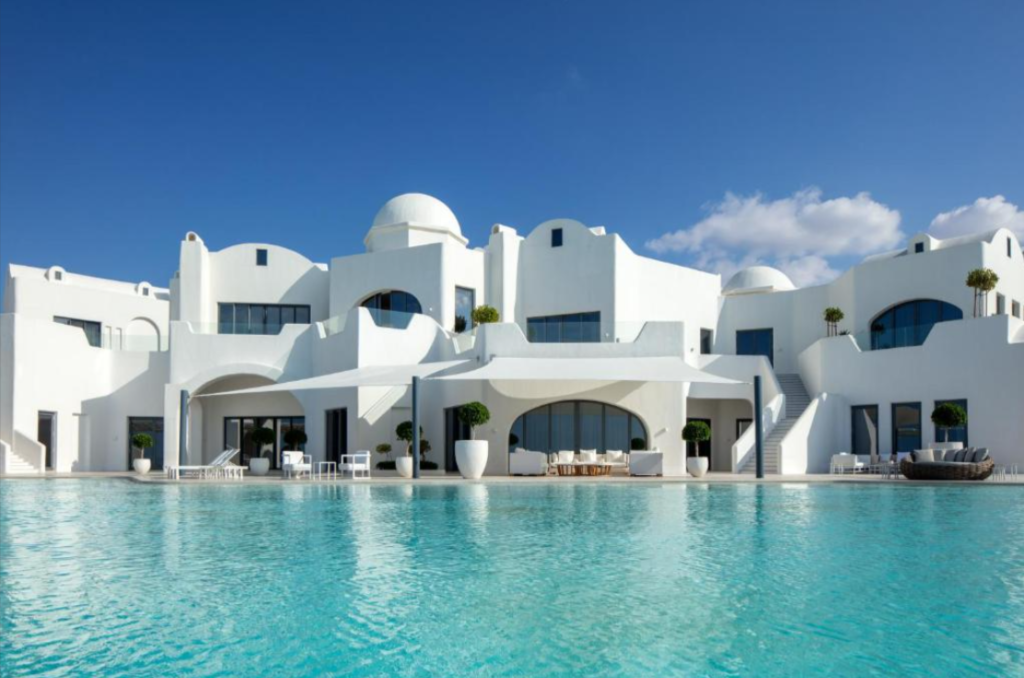
Anantara offers seclusion that borders on absolute: 22 rooms, an adults-only (18+) format, and a physical ceiling of roughly 90–100 guests. That’s both the asset and the hard constraint: the venue cannot be “stretched” for a larger wedding no matter the budget, because room inventory doesn’t scale. A less-discussed operational upside: the villa’s unbroken white facades work as a ready-made surface for 3D projection mapping with no temporary backing structures required, but that same white minimalism means a wedding built around heavy traditional decor (Arabic or Indian) has nowhere to “breathe”: the architecture crowds out any ornamental script.
One&Only Royal Mirage is the inverse case: 65 acres, three separate properties, a capacity range of 50 to 700 guests. Here the couple isn’t paying for privacy (the grounds host multiple concurrent events across the resort); they’re paying for brand recognition and architectural density. A risk producers flag regularly: splitting the Royal Ballroom into three zones raises non-trivial sound isolation and service-logistics questions. What reads as flexibility in the brochure requires its own technical rider in practice.
Axis 2: Climate Window vs. Seasonal Pricing
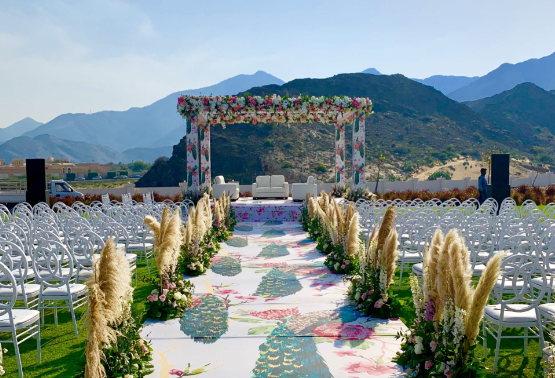
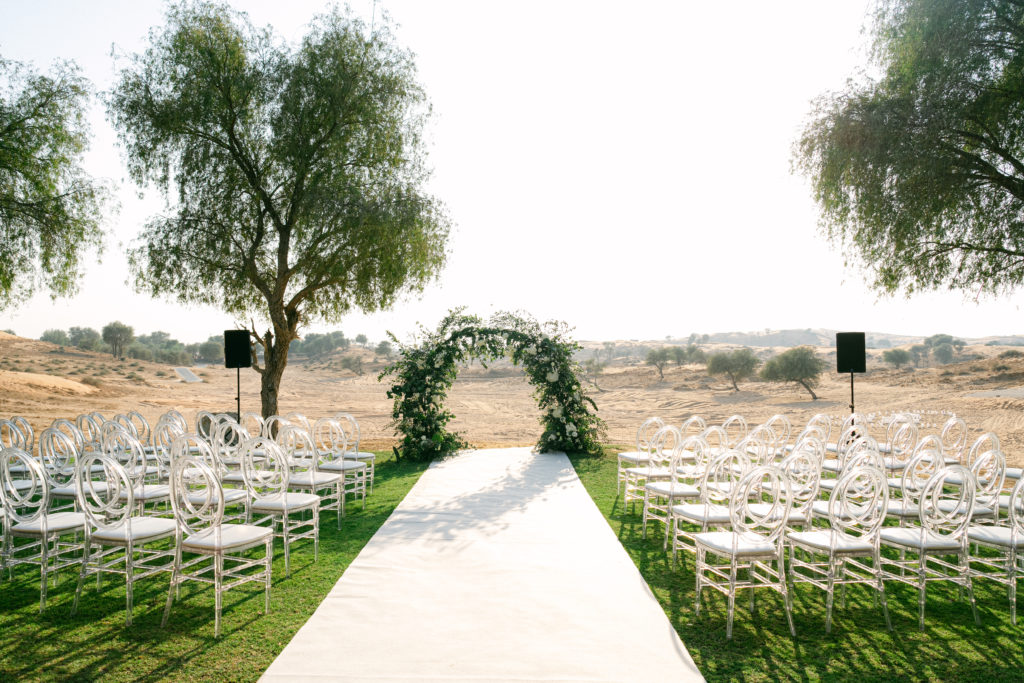
The Ritz-Carlton Ras Al Khaimah, Al Wadi Desert runs the narrowest operating window of the five. A gated 1,235-acre private reserve delivers something no Dubai property can sell: genuine desert isolation, a falcon delivering the rings, an open-sky majlis tent. But that same open sky turns the venue into a seasonal asset: from May through September, daytime temperatures make an outdoor ceremony physically unworkable, not just uncomfortable. A producer who pitches Al Wadi for a summer date either doesn’t know the venue or is knowingly passing the risk on to the guests.
InterContinental Fujairah Resort partially solves this through geography: the east coast runs several degrees cooler than the west, and the Grand Lawn (650 guests, mountains and ocean in the same frame) functions as a workhorse for large, multi-day Indian weddings with a full resort buyout, at 1.5–2x lower cost than comparable capacity in Dubai or Abu Dhabi. The trade-off runs the other way: for guests coming from Dubai, that’s ninety minutes to two hours each way, and part of what’s saved on the venue gets absorbed by transport and transfers.
Axis 3: Cultural Format vs. Spatial Flexibility
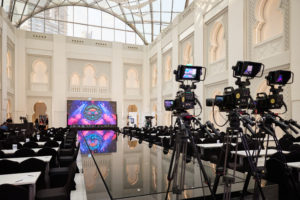
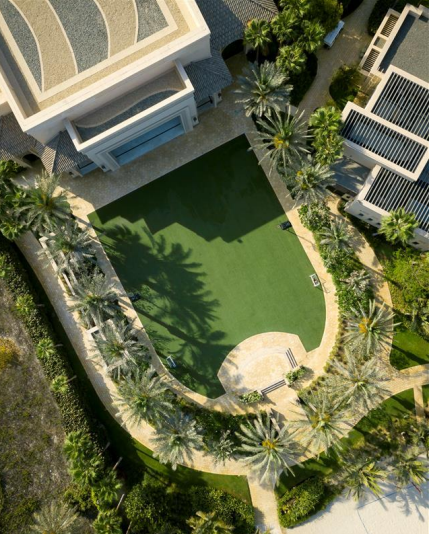
Mandarin Oriental Jumeira is a test case for what happens when a venue chooses a contemporary aesthetic over an Arabic one. Burj Khalifa in frame is a strong asset for Western and Asian audiences looking for “urban” Dubai rather than an “Arabian fantasy”, but that’s precisely why the format sits awkwardly with traditional Arabic or Indian ritual sequences: the minimalist, floor-to-ceiling-glass, 700-sqm ballroom needs a full decor build from zero, unlike One&Only or Fujairah, where the architecture already does part of the work.
What This Means in Practice
The recurring mistake at the briefing stage is picking a venue off a photograph rather than by which of the three trade-offs a couple is actually prepared to accept: a narrow window in exchange for authenticity (Al Wadi), a logistics detour in exchange for budget (Fujairah), or a full decor spend in exchange for a contemporary image (Mandarin Oriental). No property on the UAE market solves all three at once. None does. A producer’s job starts with naming the trade-off out loud, not hiding it inside the deck.