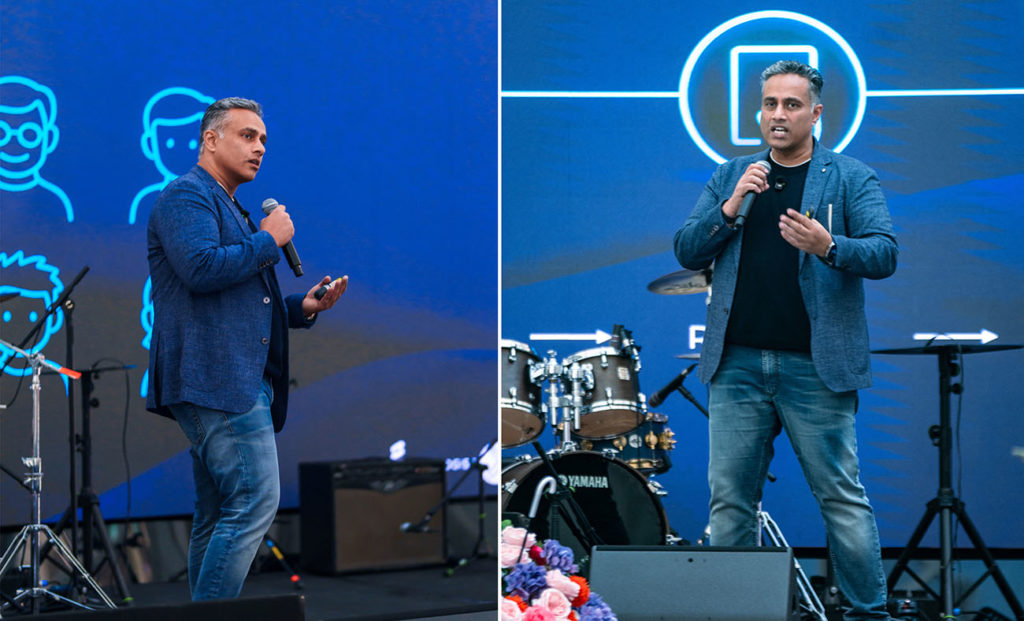
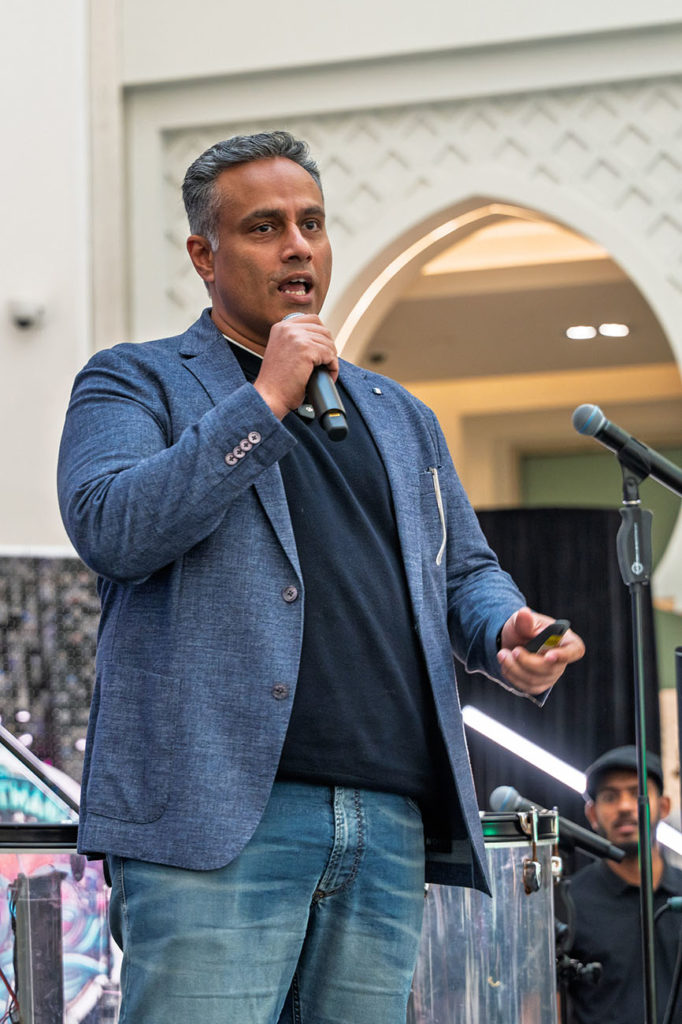
EventMag.Me talks to Sujoy Cherian (@TechnologistDXB) - Creative Technologist, CEO of Option 1 Group, three-time Guinness World Record holder
 Q: What tends to fail most often in live event technology environments?
A: It’s rarely the technology itself. The real issue is a lack of clarity around ownership and decision-making. Systems don’t fail in isolation – people do. Most breakdowns happen at the intersection of departments: content vs. AV, lighting vs. media servers, or creative vs. operations.
Another common issue is over-complexity. Teams try to push too many systems without simplifying the workflow. When something goes wrong, no one knows where the problem originated.
The biggest lesson I’ve taken from this: if a system needs explanation during a live show, it’s already too complicated.
Q: What kind of technical architecture do you typically implement for complex live experiences?
A: I approach every project like a control system, not just an event. That means clear signal flow, defined hierarchies, and separation of critical and non-critical layers.
At a high level, I work with:
One central control logic – not multiple competing ones
Independent systems that can operate even if one fails
Clean data flow between content, lighting, audio, and interactivity
Minimal reliance on “last-minute integration”
And of course my secret coded Cue Sheet
I prefer modular builds over monolithic systems. It gives flexibility, but more importantly, it gives you control when things go off-script – which they always do, especially in the Middle East and Asia.
Q: Where does AI genuinely deliver measurable value in events – and where is it still mostly hype?
A: AI is powerful when it removes friction, not when it tries to replace creativity.
Where it works:
Audience data analysis and behavior prediction
Real-time content adaptation based on inputs or engagement
Operational efficiency – scheduling, logistics, and reporting
Where it’s still hype:
Fully “AI-driven experiences” without human direction
Generic content generation that lacks context or emotional depth
Over-automation in live environments where human judgment is critical
In live events, timing and instinct still matter. AI can assist, but it shouldn’t lead – for now.
Q: How do you design redundancy into live systems to ensure reliability under real-world pressure?
A: Redundancy is not about duplication – it’s about intelligent backup.
Every critical system should have:
A fallback that is simpler, not equal
A manual override option – this is never optional, never skipped
A human who understands both the primary and backup systems
I also believe in designing “graceful failure.” If something drops, the audience shouldn’t feel a crash – they should experience a transition.
Q: What does “control” actually mean in measurable terms? Which metrics define it for you?
A: Control is not about restricting – it’s about predictability under pressure.
For me, control is measurable through:
Latency: how quickly systems respond
Recovery time: how fast you can correct an issue
System independence: how many systems can fail without collapsing the experience
Human override capability: how easily a trained operator can step in
But beyond metrics, control is confidence. When my team knows that no matter what happens, there’s a path forward – that’s real control.
At the end of the day, live experiences are not about perfect execution. They’re about controlled adaptability. Technology should give you that edge, not take it away. Our job is to ensure #wemakeithappen
The Portal Reveal:
What a Live Recovery Actually Looks Like
Theory is one thing. The following account – shared by Cherian from a large-scale immersive opening show – is what his control architecture looks like when it faces its real test. No client or event is named directly; the focus is the systems philosophy at work.
The Setup
The centrepiece of the show was a fully automated mechatronic LED reveal system: two massive LED walls physically split apart while synchronised content moved in the opposite direction, creating the illusion of a transparent portal opening into another environment.
On paper, the sequence was flawless. The challenge was not the animation itself, but maintaining synchronisation between physical motion, media playback, lighting, artist timing, and audience perception – simultaneously, under live pressure. Even a slight latency shift between the mechanical movement and the content engine could instantly break the illusion.
The Failure
During final execution, an unexpected backstage cable obstruction caused one side of the moving screen to jam – moments before the reveal sequence completed. The risk scenario they had rehearsed for had just become real.
The Recovery
Because the system architecture was built on layered control logic rather than single-point dependency, parallel fallback protocols activated immediately:
- Manual mechanical override teams took control of the moving structure
- Media playback was held in a controlled state to prevent visible sync drift
- Backup show callers initiated alternate lighting distraction cues – designed specifically for visual interruption scenarios
- Atmospheric haze and silhouette lighting redirected audience attention while recovery took place
Within seconds, the obstruction was removed. Synchronisation was restored. The reveal completed without visible disruption.
The Lesson
That moment reinforced a philosophy Cherian has applied ever since: the objective in live experiences is not eliminating failure. It is engineering systems that recover so intelligently the audience never realises failure occurred.
It also revealed something about the nature of the cue sheet. Over the years, his have evolved far beyond traditional timelines. They now function as operational recovery maps – layered with fallback logic, alternate visual masking cues, manual overrides, and human decision trees.