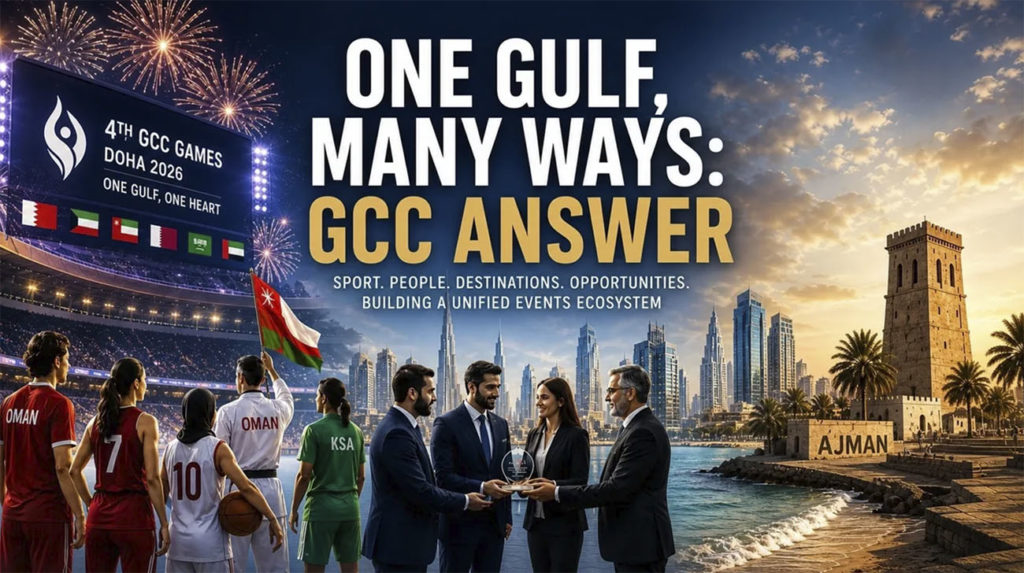

1. Qatar Hosts the 4th GCC Games
Today, May 11, Doha officially opened the 4th GCC Games – the region’s largest multi-sport event, running through May 22. The opening ceremony took place at Al Shaqab Arena under the theme “One Gulf, One Heart.” Presidents of the National Olympic Committees from all six member states attended.
Over 1,000 athletes are competing across 17 disciplines – from swimming and athletics to padel, snooker and 3×3 basketball. Ten venues are in use: Aspire Dome, Hamad Aquatic Centre, Qatar Sports Club and others – the same infrastructure Qatar built for FIFA 2022, now running at full capacity.
Oman is fielding 11 national teams. Flag-bearers for the opening ceremony were taekwondo athlete Nibras Al Tooqi and women’s 3×3 basketball player Shamsa Al Dhaha Al Khinji. The country is aiming to surpass its all-time record of 32 medals, set at the Kuwait Games in 2022.
What this means for the industry. The GCC Games are a clear case study in how sports infrastructure and event expertise convert into soft power. Qatar is methodically using Doha as a testing ground for increasingly large formats — from regional games to the Basketball World Cup 2027. For event professionals, this translates into a growing pool of experienced local contractors, technical specialists and logistics partners.
2. Dubai: Al Safeer Programme - Impressive Numbers, but What Comes Next?
This week Dubai Business Events held its annual awards ceremony for the Al Safeer Congress Ambassador Programme. The recognition is well-deserved: according to 2025 data, the programme has grown to over 370 members – academics, physicians, technology leaders and government officials – and secured 249 winning bids with an expected audience of 127,000 delegates. ICCA ranked Dubai first in the world for average attendance per association meeting.
Recognising these people is the right thing to do. They did real work.
But behind these figures sits a question that official press releases do not ask: how many of those 249 bids will actually happen? The pipeline was built in 2025 – during a period of growth, record conversion rates and optimistic forecasts. It now has to materialise in 2026, when the market looks fundamentally different. Geopolitical instability, corporate budget revisions, postponements to “a quieter moment” – all of this is landing now, on events that seemed confirmed just a year ago.
What this means for the industry. The Al Safeer model is conceptually sound: it operates through the reputational capital of specific individuals rather than venue discounts. That is meeting architecture at a governmental scale. But bid records and event delivery records are different metrics. The real test begins when DBE publishes data on the actual realisation of the 2025 pipeline.
3. Ajman Eyes the Global Market
Ajman’s Department of Tourism, Culture & Media (ADTCM) is rolling out a series of initiatives to establish the emirate as a meaningful travel destination. Key moves: a roadshow across UK cities (Leeds, Liverpool, London), a strategic partnership with Germany-based tour operator Vtours, and a hospitality support package including fee deferrals and partial licence exemptions for hotels.
What this means for the industry. Ajman is betting on affordability against an overheated Dubai. This is the classic second-city strategy: capturing spillover demand. For mid-budget corporate events, it’s a genuinely interesting niche that almost no one is taking seriously yet.
4. Global Context: The MICE Market at a Crossroads
According to multiple research firms, global MICE tourism is valued at approximately $56 billion in 2026 and is on track to reach $103 billion by 2035 at a CAGR of around 7%. Measured more broadly – across the full meetings industry – Fortune Business Insights puts the figure at $1.34 trillion in 2026, growing toward $3 trillion by 2034.
The Middle East and Africa region is growing faster than average – roughly 11.4% annually – driven by large-scale infrastructure investment in Saudi Arabia and the UAE.
Key trends flagged by Converve analysts in their May 2026 review:
- ESG as a barrier to entry. Multinationals are increasingly excluding venues that cannot verify their carbon footprint. ISO 20121 is shifting from competitive advantage to baseline requirement.
- The second city as the new norm. Overloaded hubs like Dubai, Singapore and Barcelona are pushing large events toward secondary cities and alternative venues.
- Premium resilience. The luxury segment is growing 38% year on year while the mass market stagnates. MICE in the premium tier is now treated as a strategic, not discretionary, expense.
A separate thread worth watching: Asia. Geopolitical risks – US-China trade tensions, visa friction – are redirecting MICE flows toward Southeast Asia. Thailand, Vietnam and India are emerging as “neutral ground”: destinations equally accessible to audiences from the US, China and Europe. For the Middle East, this trend has a direct implication – some events that might have landed in Dubai or Doha are instead going there.
The Week in One Paragraph
The region is moving toward integration of its events markets faster than most observers notice. The GCC Games are not simply sport – they are a demonstration that six states can operate as a single organisational body. Al Safeer shows that human capital is the most effective tool for attracting congresses. And Ajman is a reminder that in any overheated ecosystem, there is room for a player willing to work at lower price points.
For everyone in the market – organisers, venues, suppliers – the message is consistent: the next three to five years will set positions for the decade ahead. Those building reputation now will be receiving briefs then.
Sources:
https://www.converve.com/event-networking-blog/mice-tourism-strategic-guide-2026/
https://cdn-0.timesofoman.com/article/171657-nebras-shams-named-omans-flagbearers-for-gcc-games