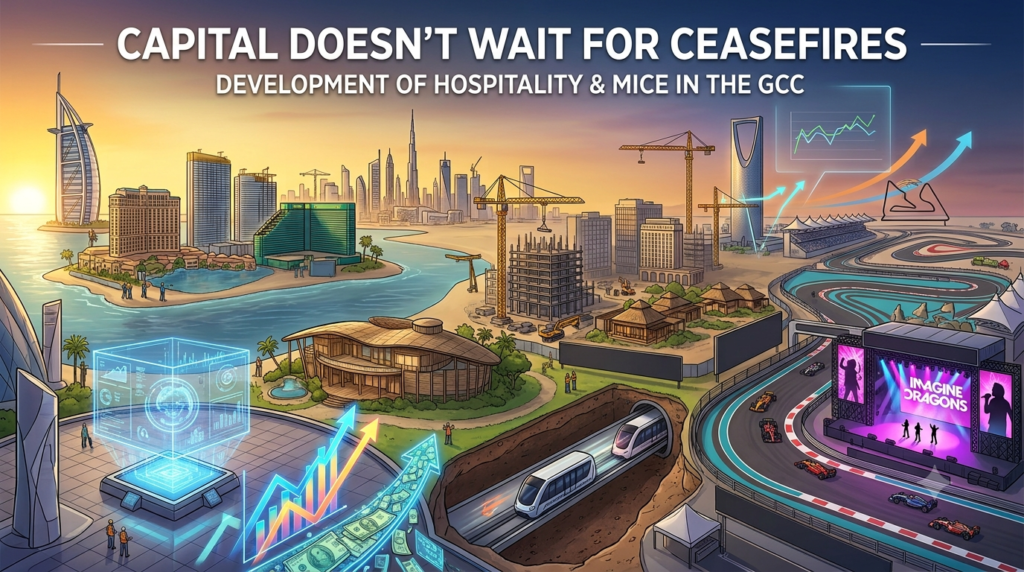

The first week of July arrived without a diplomatic breakthrough. The funeral in Tehran ran through the week, the negotiating track stayed frozen, and the region’s security picture did not meaningfully improve. None of that stopped the GCC hospitality and events market from producing some of its most substantive business news of the year.
Deals were signed. Headquarters were moved. Construction started. Forecasts were published. The market is not recovering on the back of a peace agreement – it is recovering in spite of the absence of one, driven by capital that has already made its bets and operators who cannot afford to wait.
MGM Dubai: Three Brands, One Island, Q3 2028
MGM Resorts International confirmed this week that its Dubai flagship will open in Q3 2028, not 2027 as previously signalled. The project – The Island by Wasl, a 1,400-room development on an artificial island in Umm Suqeim – will carry three of the company’s most recognisable brands: Bellagio, Aria and MGM Grand, each operating as a distinct property under one roof. Construction is being delivered by China State Construction Engineering Corporation under an AED 4.4 billion contract, and CEO Bill Hornbuckle confirmed the build is on schedule.
There is no gaming component. MGM is entering Dubai on hospitality alone, which is both a constraint and a signal – the company is prepared to commit at this scale on the strength of the destination’s meetings, entertainment and leisure fundamentals, without the revenue floor that casino operations provide. For the events industry, the project adds three internationally branded hotel conventions to Dubai’s supply picture, each carrying its own loyalty base and group sales infrastructure.
Soneva Moves Its Headquarters to Dubai
Soneva Group, the ultra-luxury resort operator built around barefoot luxury in the Maldives, announced the relocation of its global headquarters to Dubai this week. Three new senior appointments accompany the move: Joanna Flint as Chief Commercial Officer – formerly Mandarin Oriental, Google and Singapore Airlines – alongside a new CFO and COO. The group is simultaneously refreshing its visual identity under the philosophy it calls Bare Luxury, which it describes not as a rebrand but as a distillation: stripping back to what matters and making that the product.
The choice of Dubai as a global HQ for an ultra-luxury brand whose properties are in the Maldives, Bhutan and Fiji is a deliberate strategic signal. Dubai offers proximity to the Gulf’s high-net-worth base, connectivity to both East and West, and an emerging ecosystem of luxury operators who are consolidating regional and global operations here. Soneva joins a growing list of hospitality brands treating Dubai as a command centre rather than simply a market.
Blacksand and Marriott: SAR 5 Billion, Ten Hotels
Signed at the Future Hospitality Summit in Riyadh on 23 June, the Blacksand–Marriott agreement formalised a SAR 5 billion ($1.33 billion) commitment to develop ten hotels across Saudi Arabia over four years. The deal spans seven Marriott brands – St. Regis, Autograph Collection, Marriott Hotels, Moxy, Courtyard, Residence Inn and Apartments by Marriott Bonvoy – covering the full spectrum from luxury to extended-stay.
The first property, The Business Address, is targeted for 2027. Three of the Autograph Collection entries are positioned as farm resorts built around the concept of the istiraha, the private rest house central to Saudi social culture – a deliberate move to embed a globally recognised brand into a distinctly local leisure format. The pipeline also includes properties in Misk City and the Metro One development adjacent to Sulaiman Al Habib Hospital. Total employment on completion: more than 6,000 roles, with a minimum 60 percent Saudi national allocation. The CEO of Blacksand identified a specific gap the deal is designed to fill: in the Misk-adjacent area, there are almost no hotels.
Accor: Volume Returns in Q4, Rates Wait Until 2027
Accor’s CEO for the Middle East, Africa and Asia Pacific, Duncan O’Rourke, gave the market its clearest recovery timeline this week. Speaking to AGBI, he said Q4 2026 will see booking volumes return to pre-conflict levels, but room rates will not follow until late Q1 or Q2 2027. Luxury will recover first, he said – the same sequencing observed after the Covid disruption. Four of Accor’s Dubai hotels have been closed for refurbishment during the demand trough, a decision that reflects both the slowdown and a calculated bet on the quality of the recovery.
The implication for the events and MICE sector is direct: the contracting window for autumn 2026 is now open and operators are pricing for volume recovery, not yet for rate recovery. Groups booking now are entering a market where supply is tightening – Accor’s refurbishments reduce available inventory – at precisely the moment when demand is beginning to rebuild.
IHG: GCC and India Fill the Rooms Europe Vacated
IHG’s regional managing director Haitham Mattar confirmed this week that forward booking pace for Q4 2026 is recovering, driven by domestic GCC travellers and the Indian market. European demand has not returned. RevPAR fell 26 percent in March and approached 50 percent in April; the recovery is structural rather than seasonal, built on the markets that maintained travel confidence throughout the conflict period rather than those that suspended it.
IHG operates 39 hotels in the UAE and 48 in Saudi Arabia. The company is expanding both pipelines. The pattern Mattar describes – Gulf and Indian demand absorbing the volume gap left by European caution – is the clearest available read on which source markets will define the recovery shape and, by extension, which delegate profiles planners should be building their autumn event programmes around.
Saudi Hotels: Occupancy Holds, Rates Compressed
Data published this week by Gastat and analysed by Knight Frank shows Saudi Arabia’s hotel sector ended Q1 2026 with occupancy at 61 percent, down two percentage points year on year, while average daily rates fell 11 percent. The compression is deliberate: operators are holding volume by absorbing rate pressure rather than letting occupancy fall further. The number of licensed hotel establishments grew 23 percent year on year, adding supply into a market that is simultaneously managing demand disruption.
Knight Frank projects 300,000 new hotel keys will be delivered across the Kingdom by the end of 2026. Makkah and Madinah remain structurally insulated – religious tourism does not respond to geopolitical advisories – and continue to perform at occupancy levels that the broader market cannot match. For the events sector, the rate compression creates a short-term window for competitive hotel contracting across Riyadh and Jeddah.
Abu Dhabi Grand Prix: Imagine Dragons, Etihad Live, December 3–6
Abu Dhabi is selling the season finale of Formula 1 2026 harder and earlier than any previous edition. The Yas Island Grand Prix Package – on sale now, starting from AED 4,091 for a three-night stay including race access and after-race concerts – is built around a renamed venue (Etihad Live, formerly Etihad Park) and a confirmed entertainment lineup: Zara Larsson and Lewis Capaldi on Thursday 3 December, Imagine Dragons on Saturday 5 December. A new series, Yasalam Classics, begins Wednesday 2 December with Andrea Bocelli.
The 2025 edition drew 339,000 fans across race weekend, a record. Abu Dhabi is positioning the 2026 finale not as recovery from the conflict year but as the definitive bookend to a compressed and chaotic season – the event where the industry gathers to close the year. For the MICE and corporate events sector, the Abu Dhabi GP window is the region’s most significant high-value hospitality activation of Q4 2026.
Formula 1 Weighs Bahrain’s Return to the 2026 Calendar
CEO Stefano Domenicali confirmed this week that Formula 1 is actively evaluating the return of the Bahrain Grand Prix to the 2026 season calendar, with a decision expected before the summer break. The proposed slot sits between the Azerbaijan Grand Prix and the Singapore Grand Prix in September – a window that exists because several Gulf races were cancelled when the conflict began in February. Bahrain’s contract with F1 runs to 2036 and is valued at $52 million per year, with an estimated $100 million annual economic impact on the island.
Turn 1 Grandstand is sold out; the main grandstand is tracking at 98 percent capacity. The commercial case for reinstatement is straightforward. The decision rests on security assurance and operational readiness timelines. If confirmed, Bahrain in September would add a major live event anchor to a GCC autumn calendar that is already the most compressed in the region’s recent history.
GCC PMI: Saudi Arabia Diverges from the Rest of the Gulf
June’s Purchasing Managers’ Index data, published this week, draws the sharpest divergence in business conditions across the GCC since the conflict began. Saudi Arabia registered 53.3 – four consecutive months of expansion, its non-oil private sector running ahead of pre-conflict trajectory. The UAE recorded 50.8, its lowest reading in five years, with the labour market contracting for the first time in four years. Kuwait registered 46.4, below the expansion threshold. Qatar came in at 47.6.
For the events and MICE industry, the PMI is a direct proxy for corporate budget confidence. A reading above 50 in Saudi Arabia means procurement decisions are being made, contracts are being signed, and event budgets are being allocated. A reading of 50.8 in the UAE means that process has slowed significantly. The implication for planners working across both markets simultaneously: the Saudi pipeline is moving, the UAE pipeline is cautious.
Dubai Loop: Construction Begins on DIFC–Dubai Mall Tunnel
The Boring Company confirmed on 4 July that physical construction of the Dubai Loop has begun, with the first precast concrete segments – 25,000 pieces weighing 45,000 tonnes in total – now being produced for the initial phase. Phase one connects DIFC with Dubai Mall, cutting journey time from 20 minutes to three. The full 22-kilometre network will comprise 19 stations and carry 30,000 passengers daily at completion, at a total estimated cost of $544.9 million.
The MICE-relevant consequence is the geography it rewires. DIFC – the location of multiple international conference hotels and the convention district – and Dubai Mall, with its adjacent hospitality and retail infrastructure, become effectively adjacent. The loop does not open during the current planning horizon, but its delivery timeline – phase one within two years – means it enters the picture for events planned in 2028 and beyond.
Sources
https://www.hoteliermiddleeast.com/news/mgm-dubai-megaproject-now-set-for-q3-2028-opening
https://www.hoteliermiddleeast.com/news/soneva-group-announces-global-headquarters-in-dubai
https://www.agbi.com/tourism/2026/07/accor-expects-dubai-hotel-market-to-recover-fully-next-year/
https://www.agbi.com/economy/2026/07/saudi-arabia-bucks-slowdown-while-war-weighs-on-gulf-pmi/
https://skift.com/2026/06/10/dubai-took-a-hit-ihg-is-betting-on-egypt-saudi-and-a-q4-recovery/