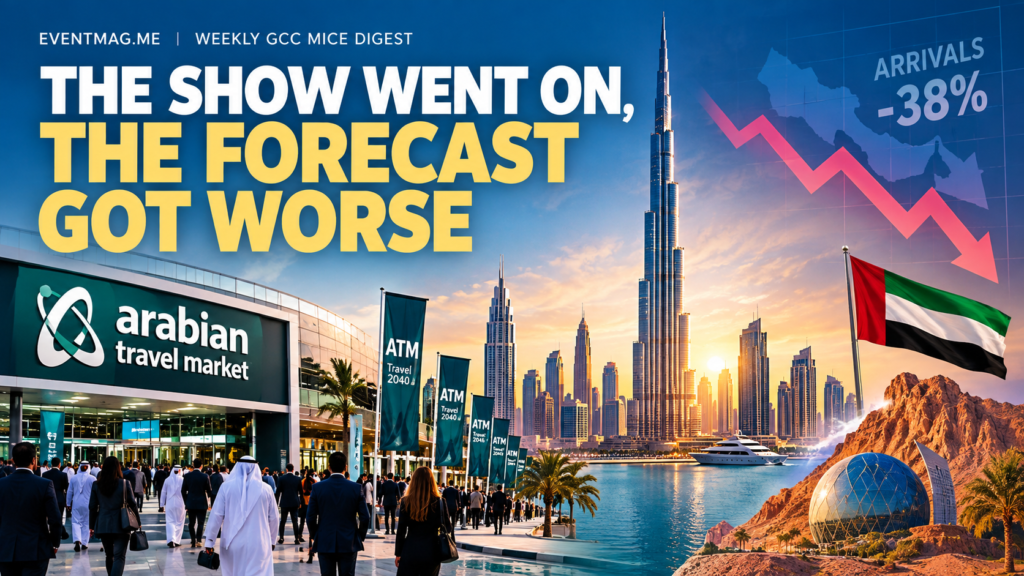

Arabian Travel Market opened this week for the third time this year on the calendar – postponed twice already, from May to August to September – and closed having done what it was built to do: 55,000-plus attendees, more than 2,800 exhibitors, nearly 58,000 pre-scheduled meetings. It happened in the same seven days that Oxford Economics revised its Gulf arrivals forecast sharply downward, Houthi projectiles reached a Saudi tourism region for the first time, and GCC tourism ministers used the show’s own sidelines to coordinate a joint response. The event and the numbers around it told two different stories at once, and neither one cancels the other out.
ATM proves the calendar still works, even softened
This year’s Arabian Travel Market ran 14-17 September at Dubai World Trade Centre under the theme “Travel 2040: Driving New Frontiers Through Innovation and Technology,” drawing more than 55,000 attendees, over 2,800 exhibitors and 6,600 hosted buyers, with 57,869 meetings scheduled before the doors even opened. Sheikh Mohammed bin Rashid Al Maktoum used the platform to confirm Dubai had welcomed roughly 7 million international overnight visitors in the first eight months of 2026, generating close to 21 million hotel room nights. Industry coverage was candid about the atmosphere: attendance ran “noticeably softer” than pre-conflict editions, even as observers called the show’s very completion “an extraordinary achievement” given the operating environment – 55-plus destination stands still showed up, from the UAE and Saudi Arabia to India, Turkey, South Africa, China and the US. The new ATM Travel Tech vertical debuted alongside it, pulling in more than 180 exhibitors from 30 countries.
The forecast moved further from where ATM needed it to be
Set against the show’s own numbers, Oxford Economics delivered a considerably harder outlook the same week: revised projections now put the drop in regional arrivals at 38%, well beyond the 11-27% range the firm had modelled earlier in the conflict. The damage is uneven by market – UAE hotel occupancy down 26% year on year across the first seven months of 2026, Dubai specifically down 29%, Oman and Qatar each down roughly 14%, while Saudi Arabia’s occupancy loss held to just 2.8%. The gap between the sharper forecast and ATM’s insistence on holding the show anyway is, on its own, the clearest single data point this week on how the region is choosing to respond to worsening numbers: not by retreating from the calendar, but by running it through the downgrade.
The Aseer campaign meets a wave it didn’t plan for
Saudi Arabia’s SAR50bn ($13.5bn) “Highlands of Arabia” push to build Aseer into a year-round tourism region – targeting some 150 million annual visitors – hit a setback this week that had nothing to do with marketing. Renewed Houthi attacks reached Jazan, damaging a mosque and nearby buildings, with schools in parts of Aseer told to keep children home as a precaution. Tim Callen of the Arab Gulf States Institute called the timing damaging for private investment and investor sentiment specifically – Aseer had already fallen short of its 9-million-visitor target in 2024, reaching 8 million, and a renewed security scare in the same province the campaign is trying to sell as a highland retreat complicates that recovery further.
Abu Dhabi keeps placing three-year bets regardless
Miral confirmed a AED12bn ($3.3bn) investment programme across Abu Dhabi’s tourism attractions this week, concentrated on Yas Island over the next five years. The centrepiece is Sphere Abu Dhabi – the first Sphere venue built outside the US – due for completion by the end of 2029, alongside a Harry Potter-branded destination developed with Disney. Miral’s own framing put the potential contribution to Abu Dhabi’s economy as high as 15%. Committing to a nine-figure build with a 2029 delivery date, in the same week Oxford Economics cut this year’s arrivals forecast, is its own kind of statement about which numbers Abu Dhabi is choosing to plan around.
GCC ministers use ATM’s sidelines to coordinate, not just attend
The tourism-ministerial response landed on ATM’s own stage. Building on the 10th GCC Ministerial Meeting for Tourism held in Manama earlier in the month, officials used a panel on the sidelines of this year’s show to detail a joint GCC tourism recovery plan covering coordinated marketing, a unified tour-guide licence, shared hotel-classification standards, tourism statistics exchange and selection of the GCC Tourism Capital for 2027 (Doha holds the title for 2026). Qatar Tourism chairman Saad bin Ali Al Kharji used the same platform to push for faster movement on the long-discussed unified GCC tourist visa. The panel cited tourism’s contribution to Gulf GDP at over 11% in 2025, against a roughly 10% global average – the kind of number ministers reach for when the point is to argue the sector is too structurally important to manage market by market.
None of this week’s five stories describe the same recovery. A trade show ran smaller but intact. A national forecast got worse. A tourism region absorbed a security shock it hadn’t budgeted for. A developer signed off on a 2029 delivery date anyway. And six governments spent the same week arguing, in public, that the only way through is together rather than apart. The forecast and the coordination effort are not opposing signals – they’re the same week’s evidence that the region now expects to manage a bad number rather than wait for a better one.
Sources
https://www.eturbonews.com/atm-2026-noticeably-softer-yet-shows-resilience/
https://www.arabianbusiness.com/travel-hospitality/arabian-travel-market-2026-dubai-sheikh-mohammed
https://www.agbi.com/tourism/2026/09/uae-hit-hardest-in-gulf-tourisms-lost-year/
https://www.agbi.com/tourism/2026/09/reality-of-war-tests-saudi-hopes-for-southern-tourism/
https://www.agbi.com/tourism/2026/09/miral-will-invest-3bn-in-abu-dhabis-tourism-attractions/
https://www.ttgmice.com/2026/09/16/gcc-puts-regional-collaboration-at-heart-of-tourism-recovery/
https://www.arabianbusiness.com/business/tourism-hospitality/gcc-tourism-recovery-plan-saudi-arabia
https://www.qatar-tribune.com/article/253191/latest-news/qatar-tourism-chief-highlights-gulf-tourism-integration-at-gcc-meeting
https://economymiddleeast.com/news/atm-2026-asia-gcc-travel-corridor-emerges-as-next-tourism-growth-engine-as-overnight-guests-reach-164-8-million-up-161-percent-since-2019/