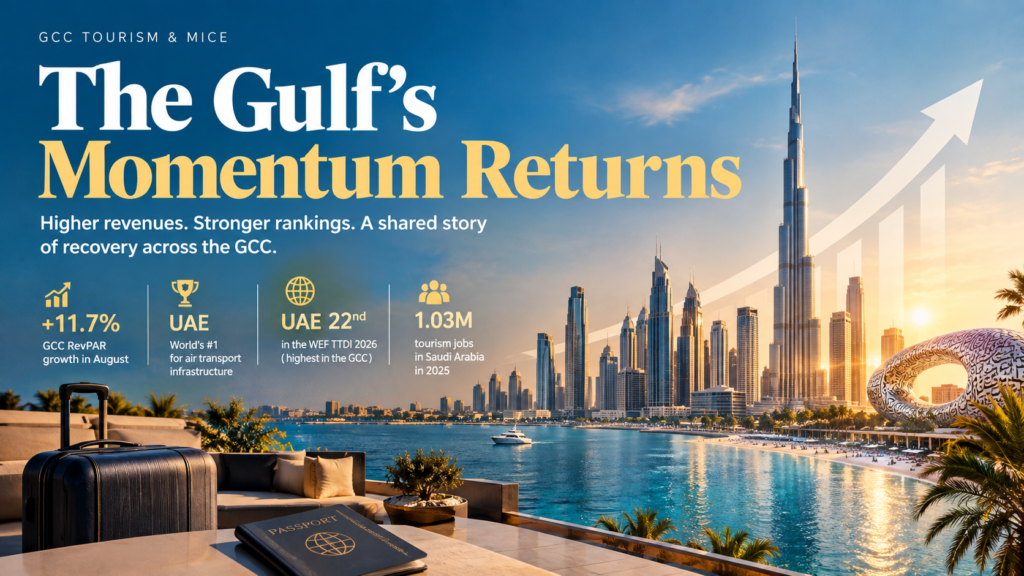

For months this digest has tracked a gap between ambition and arithmetic: governments announcing visa schemes and investment programmes while occupancy data kept falling. This week, for the first time, two independent measurement systems pointed the same direction at once. The World Economic Forum ranked Gulf destinations among the world’s fastest-improving tourism economies. STR’s own revenue data confirmed the region actually earned more from every available room in August than a year earlier. Ambition and arithmetic, briefly, told the same story.
The world’s scorecard says the fundamentals improved
The World Economic Forum’s Travel & Tourism Development Index (TTDI) 2026, launched 25 September in partnership with Zurich Insurance Group, ranked the UAE 22nd among 110 economies – the highest in the GCC – and named it the world’s number one for air transport infrastructure. Saudi Arabia climbed three places to 29th, a 7.8% score gain since 2019 that the WEF called the second-largest seven-year improvement of any economy assessed; the report singled out the Kingdom’s tourism workforce strategy specifically, citing close to 1.03 million tourism jobs in 2025 and Saudi women rising to roughly 47% of the tourism workforce, up from 5% in 2018. Qatar posted the bloc’s sharpest single gain, jumping ten places to 47th. Bahrain placed 55th, Oman 62nd (fifth in the Arab world) and Kuwait 88th. The report’s own framing carried a pointed caveat for the region: the same index that ranks these economies among the world’s fastest-improving also names the conflict-driven disruption to Middle East aviation as the year’s starkest reminder of how exposed the sector remains.
STR’s revenue data agrees, for the first time in months
Where the WEF index measures conditions and policy, STR measures money – and this week its numbers moved in the same direction. Revenue per available room across the six GCC countries grew 11.7% year on year in August, with gains in both occupancy and average daily rate, extending a year-to-date RevPAR increase of 7.8%. The growth wasn’t simply a low base effect: supply growth across the bloc has slowed to just 0.6% year to date, well below the region’s 4.5% long-term average, meaning existing rooms are earning more rather than new inventory diluting the numbers. STR pointed to Salalah and Ras Al Khaimah as markets that had specifically raised their regional profile through the disruption, with Abu Dhabi “stepping onto the world stage” as a separate driver of the gains.
The bloc keeps building the shared plumbing behind the numbers
The unified GCC tourist visa – discussed at the Manama ministerial meeting on 10 September and referenced again by Qatar’s tourism leadership at Arabian Travel Market – moved a step closer to implementation this week, with September 2026 now cited as the most concrete signal yet that a functioning cross-border visa programme is being prepared, even as officials stopped short of confirming a launch date. Oman added a smaller, more immediate data point: 700 new hotel rooms confirmed for delivery by year end, part of the steady room-count growth STR’s supply figures show holding well below historical norms across the bloc.
Awards, tournaments and capital keep landing on the calendar regardless
Three smaller signals rounded out the week. Arabian Business opened entries for its inaugural Industry Awards, with hotel brands given until 28 September to submit a year’s worth of performance evidence across 28 categories, ceremony to follow in November – a new recognition platform launching into the market rather than waiting for it to settle. Saudi Arabia opened the 27th Arabian Gulf Cup on 23 September, hosting the regional football tournament through 6 October, a fixture that fills stadiums and hotel rooms across host cities regardless of the broader tourism narrative. And in Abu Dhabi, LIVEX 2026 opened with more than 20 partner organisations confirmed for the liveability and investment exhibition – another instance of a sector-specific platform choosing to launch into the current climate rather than around it.
None of this closes the gap this digest has tracked since spring – flight capacity into the Gulf remains constrained, and the WEF’s own report says so in the same breath as it hands out record rankings. But for the first time in months, the index that measures long-term conditions and the data that measures this month’s actual revenue are describing the same recovery rather than two different ones. That alignment, more than any single ranking, is the story of this week.
Sources
https://www.muscatdaily.com/2026/09/28/oman-ranks-62nd-in-wef-tourism-development-index/
https://www.costar.com/products/str-benchmark/resources/data-insights-blog/middle-east-hotel-performance-heats
https://www.travelandtourworld.com/news/article/h59h8dmgo3p2/