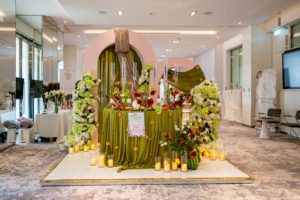


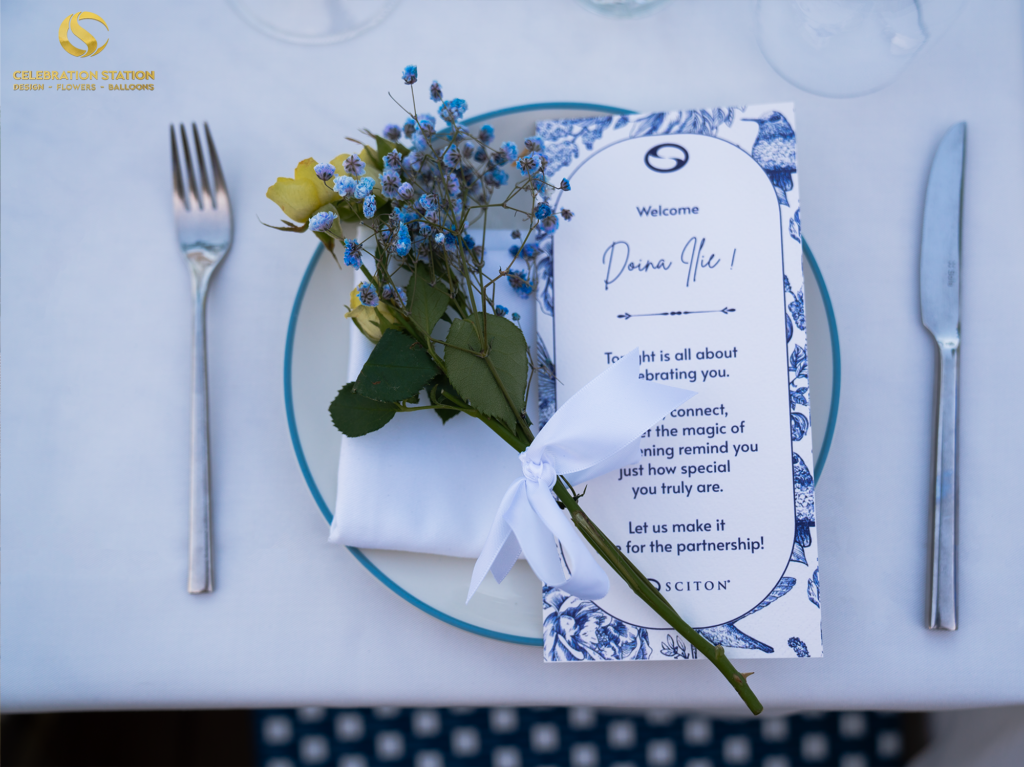

The next visual language of events will not come from another mood board. It will come from decorators who look outward, think spatially and build with conviction.
When Inspiration Becomes Repetition
There is a moment every decorator recognises: you look at a newly published event and feel you have already seen it. Not the exact celebration, perhaps, but its visual vocabulary: the familiar curve of the backdrop, the same cloud of flowers, the same palette travelling from one mood board to the next. The execution may be beautiful, the materials expensive and the photography flawless, yet the idea itself feels strangely familiar.
We have never had access to more inspiration, but our visual world can sometimes feel smaller. Instagram, Pinterest and international event platforms allow an idea to cross continents within hours. That access is extraordinary. It introduces us to makers, materials and techniques we might never otherwise discover, and it has created a global creative conversation. The complication is that when the same references reach everyone at once, inspiration can quietly become repetition.
Working in the UAE, we meet clients who are informed, well-travelled and visually confident. They arrive with saved images, colour preferences and a clear sense of the atmosphere they want. We welcome those references because they reveal emotion and expectation. The problem begins only when the reference is treated as a finished instruction rather than the beginning of a conversation.
For us, the decorator’s role is not to reproduce a photograph. It is to understand why the client responded to it. Was it the scale, softness, contrast, movement or light? Was it the intimacy of the room, the confidence of one sculptural gesture, or the way the image made luxury feel effortless? Once that answer is clear, the original picture has completed its task. We can close it and begin designing for the actual architecture, occasion and people in front of us.
This is the difference between copying an appearance and translating an emotion. The first produces a recognisable version of something that already exists. The second can produce a space with identity. A memorable event should feel as though it could exist only for this client, in this place and at this moment.
That responsibility is especially important now, when an event is often encountered twice: first by the guests who live through it and later by the much larger audience who sees it online. A design may photograph beautifully and still feel empty in person. The camera rewards a focal point; the guest remembers a journey: the anticipation at the entrance, the shift of light, the surprise overhead, the intimacy of the table and the final view when leaving. We have to design for both, without allowing the photograph to replace the experience.
The market may reward speed, but memory rewards identity. The most useful question is therefore not, “Which reference will the client approve fastest?” It is, “What is this event trying to say that no other event needs to say in exactly the same way?”
A mood board should be a doorway, not a destination.
The Courage to Leave the Formula
The event industry naturally favours what can be understood, priced and approved quickly. A familiar stage shape is easy to present. A known floral composition is easy to calculate. A venue already has conventional focal points, and the production team knows how to treat them. These efficiencies are necessary, particularly when timelines are tight. The safe answer is not automatically the wrong one; it becomes a limitation when we stop asking whether it truly serves this particular event.
Creative risk is often misunderstood. It is not carelessness, excess or an attempt to make something strange for attention. The most convincing risks are disciplined. They are supported by research, proportion studies, material samples, structural calculations, lighting trials and a production team able to turn an unfamiliar idea into a reliable environment. The finished result may feel effortless; the process behind it rarely is.
As professionals, we have to challenge ourselves before we challenge a client. Have we chosen this form because it is right for the space, or because we already know how to build it? Are the flowers creating architecture, or are they being added because an empty corner makes us uncomfortable? Must a stage behave like every other stage? Could the entrance begin before the guest sees the venue? Could a ceiling, corridor or overlooked service route become part of the story?
These questions do not necessarily produce a more complicated design. Often they lead to greater clarity. One suspended form can create more tension than a room filled with disconnected details. A deliberate area of emptiness can make the next reveal feel spectacular. One material, used according to its natural behaviour, can transform a familiar palette. Innovation is not measured by how much we add; it is measured by how decisively an idea changes the experience.
The client’s trust is part of that process. When a composition is asymmetrical, a scale is unusual or a material is being used in a new way, a polished rendering alone may not be enough. We need to explain the logic. Samples show texture; mock-ups prove proportion; lighting tests reveal reflection and transparency. A floor plan demonstrates that the idea still respects guest movement, sightlines and service. These practical tools do not weaken imagination. They allow everyone involved to believe in it.
There are, of course, real limits: safety, budget, installation time, venue rules, climate and the availability of skilled hands. I do not see those limits as the opposite of creativity. They are part of the design brief. A bold concept that cannot be installed securely or experienced comfortably is not resolved. The professional achievement lies in preserving the emotional idea while solving its physical reality.
Not every event needs to be avant-garde, and not every experiment needs to be loud. The risk may be subtle: reducing the palette, changing the rhythm, using light as a material or allowing one sculptural object to stand alone. What matters is that the decision is intentional, and that the team does not retreat to convention simply because convention is easier to explain.
Once we leave the formula, a more interesting question appears: if we are no longer looking only at other events, where should we look?
Creative risk becomes design only when imagination and discipline arrive together.
Looking Beyond Events
When event references stop surprising us, we look outside the event world.
Architecture teaches us to respect proportion, rhythm and negative space. A building derives its power not from occupying every surface, but from considering weight, height, light and emptiness together. The relationship between a curved wall and a narrow opening, or between a monumental volume and one precise line of light, can be more instructive than hundreds of photographs of completed stages.
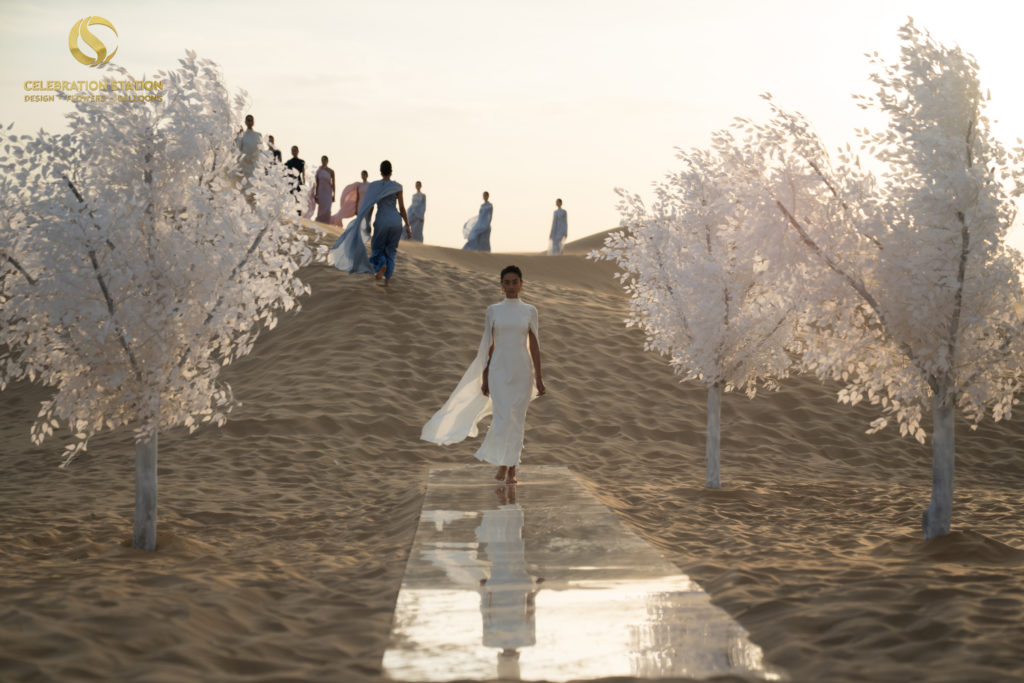
Fashion offers a different lesson: movement. A garment changes with the body, revealing texture and silhouette gradually. That way of thinking can turn fabric from a background material into a structural idea. A pleat can shape a wall. A sleeve can suggest a canopy. The tension of a couture silhouette can inform an entrance, while transparency can teach us how to reveal a room without showing everything at once.
Hospitality design reminds me that a guest does not experience a space as one photograph. A restaurant or hotel unfolds through thresholds, pauses, turns and discoveries. An event can be composed with the same progression: anticipation on arrival, expansion in the main room, intimacy at the table and one final image that remains after the celebration ends. This idea of a guest journey is often more valuable than adding another decorative object.
Nature remains the most sophisticated reference because it rarely depends on perfect symmetry. Branches respond to gravity, flowers open at different speeds and landscapes create depth through irregularity. Learning from nature does not mean covering every surface in greenery. It means understanding growth, seasonality, imperfection and scale. A floral installation feels more alive when it appears to gather, lean, climb or disperse rather than simply fill a measured area.
Cinema, theatre and contemporary art contribute narrative. They teach us what to reveal, what to withhold and when to change the atmosphere. A strong installation can behave like a scene: it establishes a point of view, directs attention and creates an emotional before and after. Shadow, sound and reflection can become part of the décor when they support that story rather than compete with it.
The goal is never to copy a façade, runway or landscape literally. A decorator translates principles. Repeated windows might become the rhythm of a ceremony tunnel. The movement of a garment might shape a suspended textile installation. The atmosphere of an old greenhouse might inspire a transparent floral environment made through contemporary fabrication.
In our process, that translation has four stages: observe, abstract, adapt and test. First, we identify what creates the emotion. Then we remove the original object and keep only its principle: perhaps rhythm, tension, reflection or growth. We adapt that principle to the event and its architecture. Finally, the team tests it at the correct scale, under the correct light and with real guests moving around it. This is the point at which inspiration becomes design rather than reference.
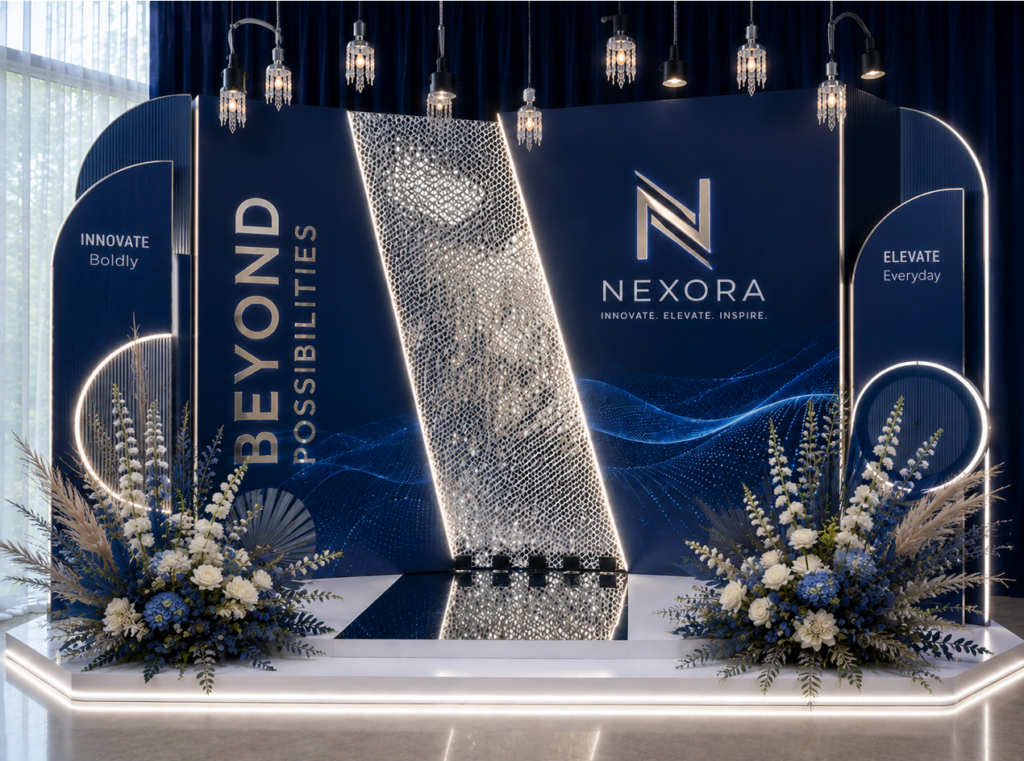
In a recent Celebration Station UAE corporate installation, for example, reflective shimmer was not treated simply as a sparkling surface. Its movement, transparency and response to light became the central experience of the photo zone. The material changed as the guest approached, so a branded background became dimensional and alive. We were no longer applying a product; we were designing with its behaviour.
Looking outside our category does more than refresh the mood board. It expands the kinds of questions we are able to ask. And sometimes the freshest answer is not found in something futuristic at all, but in a technique we thought we already knew.
Trends are born when a principle travels from one creative world into another.
The New Is Often an Intelligent Return
The future of décor is not built only from materials that have never existed before. Very often, it begins by looking again at something the industry has decided is old.
Draping, painted scenery, candlelight, mirrored surfaces, theatrical props, ornamental metalwork and traditional floral craftsmanship all carry long histories. None is automatically contemporary or outdated. Relevance comes from proportion, context and combination. A familiar technique can feel entirely new when its scale changes, when its function changes or when it enters an unexpected relationship with the architecture.
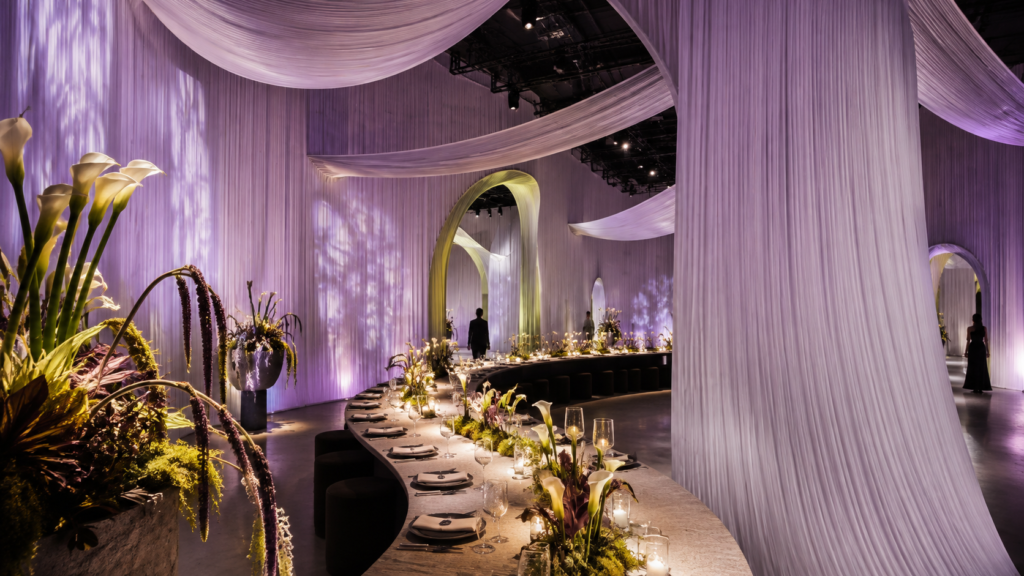
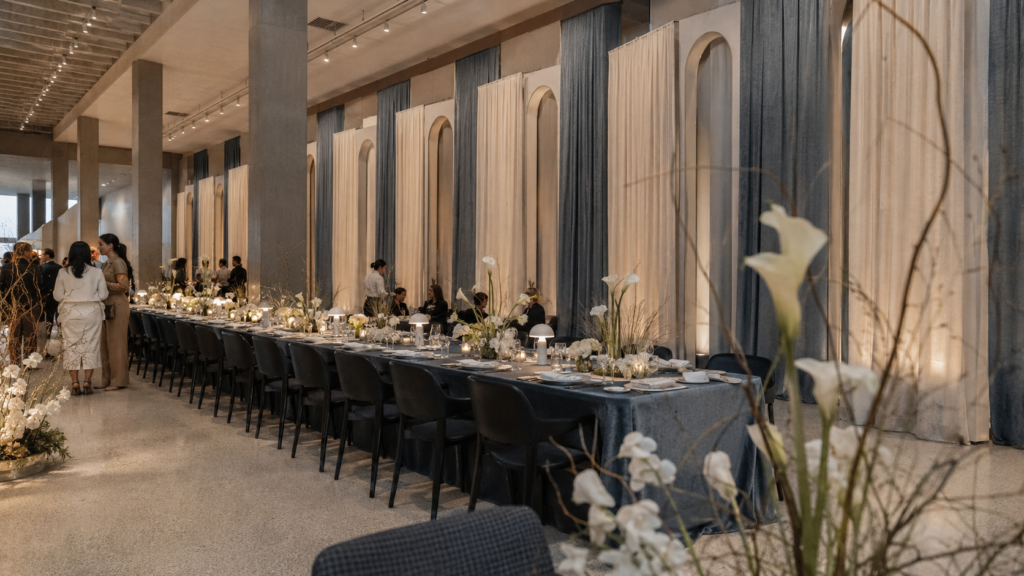
Consider draping. Used conventionally, it hides a wall. Reimagined, it can become a pleated ceiling, a sculptural curtain, an architectural frame or a threshold that reveals the room in stages. Its folds can catch light like the surface of a gown, soften acoustics and alter the apparent height of a venue. The difference is not simply a more fashionable colour; it is a new role for the material.
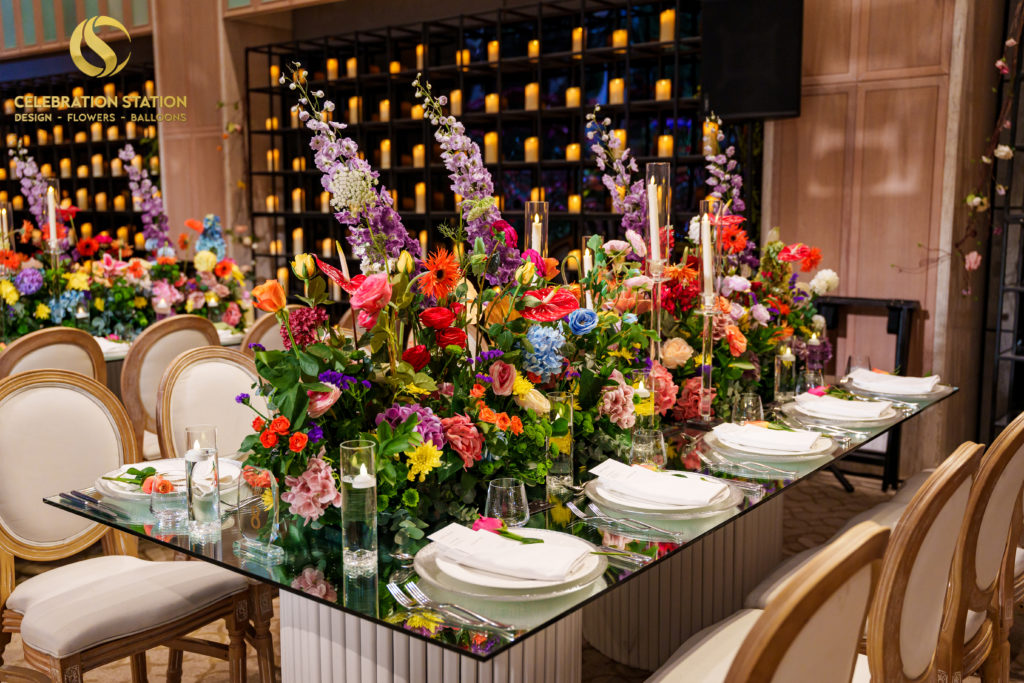
The same is true of reflection and candlelight. A mirror once used for obvious glamour can dissolve the edge of a room, multiply a floral form or make an installation appear to continue beyond the venue. Candlelight can move from a table accessory to a low landscape that controls depth, pace and intimacy. Painted scenery can meet projection; hand-formed metal can sit beside digital fabrication; classical floristry can be broken into an asymmetrical field that feels almost like a natural habitat.
This is not nostalgia for its own sake. We are not interested in recreating a historic style perfectly unless the occasion demands it. We want to understand what made a technique emotionally powerful and give that power a contemporary reason to exist. The past provides a vocabulary; the designer decides what the new sentence will say.
Heritage-led events make this responsibility especially clear. A cultural symbol cannot be reduced to a convenient theme or a surface graphic. It must be researched, respected and translated into the guest experience. In our own work, that may mean combining a recognisable historic image with transparent materials, precise lighting and modern fabrication. When the relationship is thoughtful, the old and the new do not compete; each makes the other more meaningful.
There is practical intelligence in revival too. Traditional techniques carry hand skills, repair knowledge and an understanding of materials that our industry should not lose. When those skills meet lighter structures, improved engineering and digital production, they can achieve forms that were previously difficult to realise. They can also encourage more adaptable pieces: elements designed to be reconfigured, refinished or used again rather than discarded after one night.
Trends themselves often move in this way. A colour returns with a different temperature. A classical arrangement comes back with a broken silhouette. A theatrical motif reappears at architectural scale. What looks like repetition from a distance may, in skilled hands, be genuine evolution.
This gives decorators a much wider creative field. We are not trapped between copying the past and rejecting it. We can edit it, question it and place it in conversation with the present. The strongest results often feel both familiar and unexpected: as though the guest recognises the emotion but has never seen it expressed in that form.
The past becomes modern when it is given a new purpose, not simply a new finish.
A Studio We Return to: NEBO Decor
These ideas become clearer when we look at studios that consistently build their own visual language. Some catch our attention through a single project. Others draw us back because their thinking continues to challenge. NEBO Decor belongs to the second group. We are genuinely a fan of their work, not because we want to reproduce its appearance, but because it encourages us to think more ambitiously about what decoration can become.
Based in Sevastopol, Crimea, and led creatively by Lilia Kutuzova, with her husband and co-founder Vladimir Kytin directing much of the production work, the studio shows what can happen when imagination and fabrication develop together. What we admire is not one signature palette or a repeatable floral style. It is their refusal to treat a venue as a neutral box waiting to be filled.
In NEBO’s work, flowers often operate as architecture rather than an accessory. Ceilings become active surfaces. Transitional areas join the guest journey. A familiar room is reorganised by scale, suspension, reflection or one unexpected object. The result is not decoration placed inside a venue; it is a temporary world with its own logic.
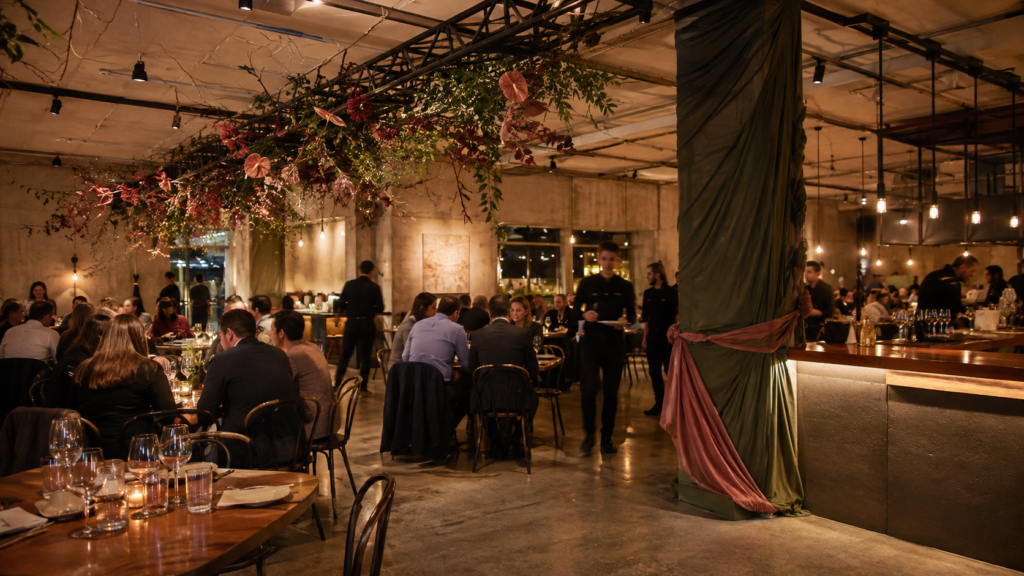
Their restaurant and café interventions are especially instructive. Commercial interiors arrive with fixed functions, circulation routes and established focal points. The predictable response would be to decorate the most visible wall and stop. In transformations such as Cataleya, the concept extends beyond one photo zone. Florals, sculptural elements and overhead gestures change how the interior is read, allowing the guest to discover the design rather than consume it in one glance. For a decorator, this is an important lesson: the venue itself can become the canvas, and the guest’s route can become part of the composition.
Across the wider portfolio, ceilings are repeatedly treated as landscapes rather than afterthoughts. Suspended flowers, reflective forms and illuminated structures establish rhythm overhead, so the guest feels the design before studying any single arrangement. Other projects are controlled by one monumental intervention (including the memorable whale-like installation) which shifts the emotional centre of an already distinctive location. These gestures work because they are not isolated props. They change the perceived scale and meaning of the architecture around them.
That level of imagination demands production discipline. The more unusual the gesture, the more exact the questions become: Where is the load carried? How will the surface behave under heat and light? Can the installation be assembled within the venue’s access window? What will be visible from the entrance, the table and the camera? The connection between Lilia’s creative direction and Vladimir’s production expertise is part of what makes the work convincing. The idea survives contact with reality.
This is also why professional admiration should never become imitation. We may look at a NEBO project and admire the suspended scale, the activation of an unexpected surface or the confidence to let one object dominate the room. The useful question is not, “How can I make something that looks like this?” It is, “What assumption did this project refuse, and what assumption should I question in my own work?”
That question sends us back to our first solution. Have we accepted the expected focal point too quickly? Is there another surface, route or perspective that could carry the idea more powerfully? Can the concept unfold as an experience rather than exist as one image? Could the location stop being a background and become an active part of the narrative?
This is what a studio with a genuine point of view contributes to the wider profession. It does more than produce beautiful photographs. It raises the standard of the questions other decorators ask themselves. NEBO Decor’s creative signature is not that every project looks identical; it is that each one shows a consistent appetite for transformation.
A creative signature is not one look repeated. It is a way of thinking that remains recognisable even when the style changes.
The UAE as a Global Creative Laboratory
For us, the UAE is one of the most demanding and exciting places in which to put all of these ideas into practice. People arrive here from across the world carrying different cultures, ambitions and definitions of celebration. A destination wedding may need to unite several traditions in one coherent experience. A corporate event may need to express an international brand while still belonging unmistakably to its location.
Here, an event is rarely only a gathering. It is often a statement of identity, achievement and place. Clients come to the UAE expecting distinction. They ask for the biggest, the coolest, the most elegant or the moment nobody has seen before. That ambition pushes our industry forward, but it also gives us a responsibility: superlatives must be translated into ideas, not simply quantities.
More flowers, a larger screen or a higher stage do not automatically create a stronger concept. A generous budget can still produce visual sameness when it is directed towards familiar symbols of luxury. The greater opportunity is to use the UAE’s extraordinary combination of cultures, venues, fabrication knowledge and technology as a laboratory for new visual languages.
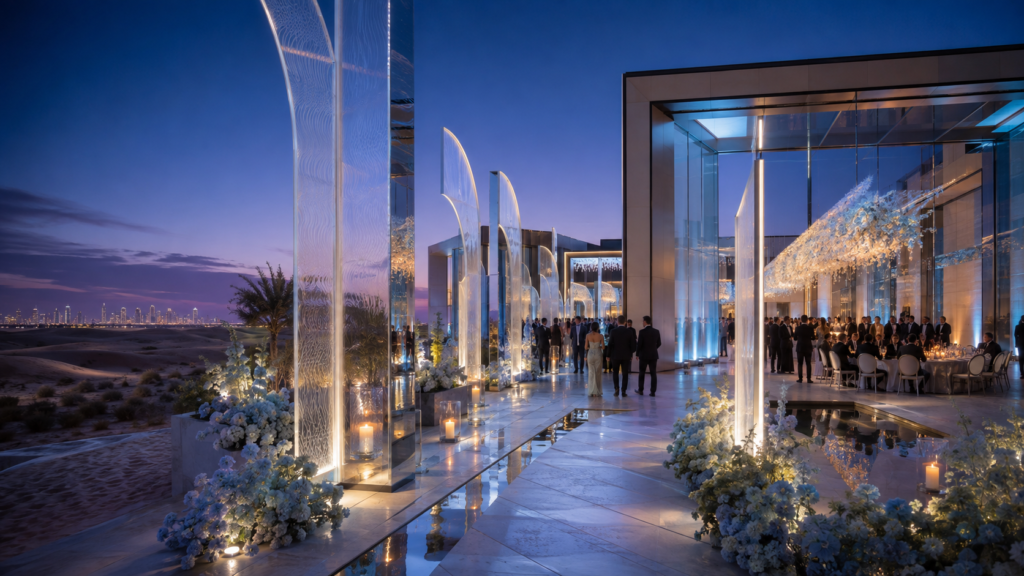
Few markets offer such creative contrast. We may work in a desert landscape one week, a glass tower the next, followed by a palace, yacht, private residence or international exhibition hall. Each environment asks for a different intelligence. The desert invites sensitivity to horizon, wind and changing light. A ballroom demands control of scale and sightlines. A restaurant requires the design to coexist with an interior that already has a personality. When the concept responds to those conditions, it becomes inseparable from the memory of the event.
At Celebration Station UAE, we see our responsibility as translation rather than importation. A reference may arrive from Milan, Istanbul, Moscow, Seoul or New York, but the finished environment must belong to this client, this architecture and this moment. That is particularly important in destination celebrations, where guests have travelled precisely because the location is meaningful. The design should not erase the destination; it should reveal it through a new point of view.
The same principle applies to cultural traditions. Bringing several customs together does not mean placing every symbol in the room. It requires listening: understanding which rituals carry emotional weight, where families need recognition and how the sequence of the celebration should unfold. The decorator becomes part designer, part editor and part storyteller, finding a visual language in which different identities can feel present without competing.
Collaboration makes that possible. Transformative work is rarely the achievement of one person standing beside a finished stage. It depends on decorators, florists, fabricators, lighting teams, planners, coordinators and technicians who are willing to solve something unfamiliar together. Creative direction gives the project purpose; production knowledge gives the idea permission to become real.
That partnership will matter even more as technology makes perfect-looking references easier to generate. When thousands of seductive images can appear instantly, the valuable professional skill is no longer finding an attractive picture. It is recognising which idea deserves to enter the physical world, and knowing how to build it safely, beautifully and meaningfully. A visual can promise anything; a professional must understand gravity, budget, guest movement, installation time, climate and the behaviour of materials under real light.
This, to us, is where the UAE can lead. The market already brings the world together. Its next opportunity is not merely to import what the world considers fashionable, but to become a place where new approaches are tested, refined and then carried outward. That requires curiosity beyond our category, respect for craft, investment in production and the confidence to present clients with a point of view.
[ФОТО] Подпись: Designs by Denis Panchenko (Celebration Station UAE)
As decorators, we are not employed only to make spaces attractive. We are entrusted with shaping how important moments are entered, experienced and remembered. A wedding, anniversary, national occasion or corporate milestone deserves more than a fashionable background. It deserves an environment with intention, one that honours the people at its centre and leaves them with a memory that belongs only to them.
The future will not be created by following the next trend more quickly. It will be created by observing more widely, editing more intelligently and producing more courageously. Our task is not simply to predict what comes next. It is to give it form.
[ФОТО] Подпись: Designs by Denis Panchenko (Celebration Station UAE)
The future belongs to those willing to imagine what does not yet have a reference.