



On the other hand, regional geopolitical tensions continue to create significant operational challenges, ranging from disruptions in air connectivity to increased caution among international organisers and corporate clients.
Recent industry reports indicate that the sector has not stalled – it is actively adapting to new realities.
Growth Remains on the Agenda, but the Pace Is Adjusting
According to current estimates, the GCC event management market is expected to reach approximately USD 7.2 billion in 2026 and grow to USD 9.1 billion by 2031, with a compound annual growth rate (CAGR) of around 4.8%. The broader events sector shows even stronger projections, increasing from USD 1.8 billion in 2025 to USD 3.1 billion by 2032 (CAGR 8.1%).
The key growth drivers remain unchanged:
- Saudi Arabia’s Vision 2030 and mega-projects (NEOM, Qiddiya, Red Sea Project)
- Dubai’s visitor economy strategy
- Qatar’s post-mega-event infrastructure legacy
- rising demand from younger audiences for immersive, tech-driven, and sports-entertainment formats
However, the current instability is already influencing short-term planning.
Hybrid and Regional Focus as Core Responses to Uncertainty
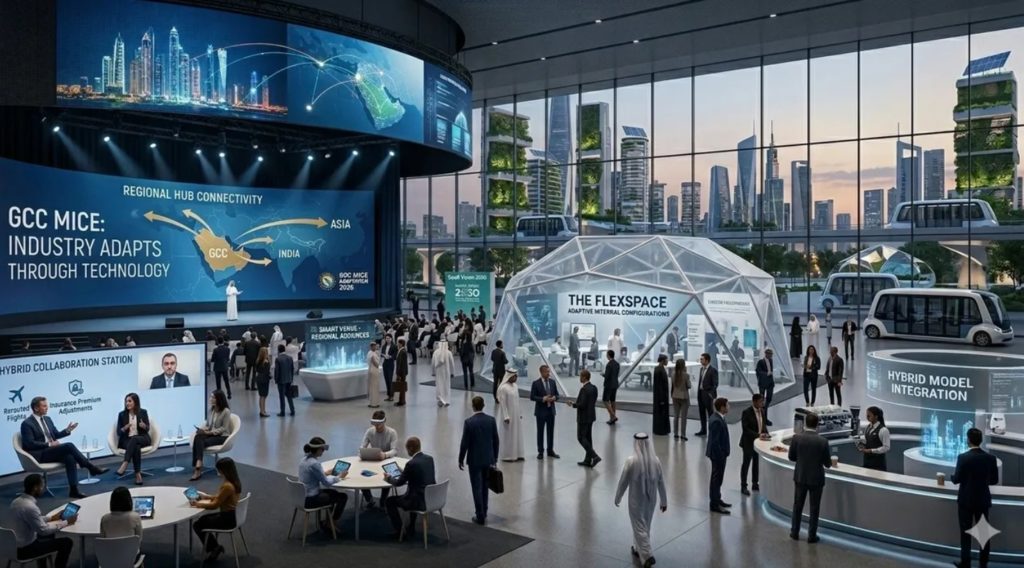
One of the most notable shifts in 2026 is the full transition to a hybrid-first model. What began as a forced response during the pandemic has now become standard practice. Event organisers are designing experiences for two audiences simultaneously: those attending in person and those joining online. Hyper-personalisation through data and AI, seamless technical integration, and a clear value proposition for both segments are now key priorities.
At the same time, there is a growing shift toward a regional audience focus. As international delegates face increasingly complex travel logistics and elevated risk perceptions, organisers are placing greater emphasis on attendees from the GCC, the wider Middle East, India, and other Asian markets. This helps maintain attendance levels while reducing reliance on long-haul travel.
Geopolitics Impacts Logistics and Confidence
Escalating tensions in the region have had a direct impact on aviation. Airlines are rerouting flights, adjusting schedules, and, in some cases, reducing or suspending routes altogether. Travel times and costs are increasing.
This has an immediate effect on the MICE sector: organisers are postponing or revising major conferences and exhibitions, corporate clients are delaying decisions, and insurance premiums for hosting events in the region are rising.
The GCC hospitality sector reflects a mixed demand pattern. While leisure tourism shows signs of recovery in certain destinations, the business and events segments remain cautious. Many planners report delayed decision-making and a shift toward more flexible or locally focused formats.
What Comes Next: Safety, Flexibility, and Technology
For the GCC MICE industry, 2026 represents a stress test. The fundamental growth drivers – infrastructure, government support, and economic diversification – remain firmly in place. In fact, periods of turbulence may strengthen the region’s position by accelerating the development of hybrid and regionally focused models.
The key to navigating this phase lies in prioritising participant safety, maintaining maximum flexibility in planning, and leveraging technology to mitigate risks and expand reach. Organisers and venues that adapt quickly will not only preserve current projects but emerge from this period with more resilient and modern event formats.
Conclusion
In the long term, the GCC remains one of the most promising regions in the world for the development of the events industry. The only question is how quickly the market will navigate the current period of turbulence.
Sources:
https://www.tradearabia.com/news/TTN_416982.html
https://www.arabnews.com/node/2634121/business-economy
https://www.c-mw.net/event-organisers-delay-decisions-amid-middle-east-uncertainty/
https://www.reuters.com/world/middle-east/airlines-reroute-flights-middle-east-2026
https://www.eventindustrynews.com/news/gcc-event-market-shifts-to-hybrid-and-regional-focus





