


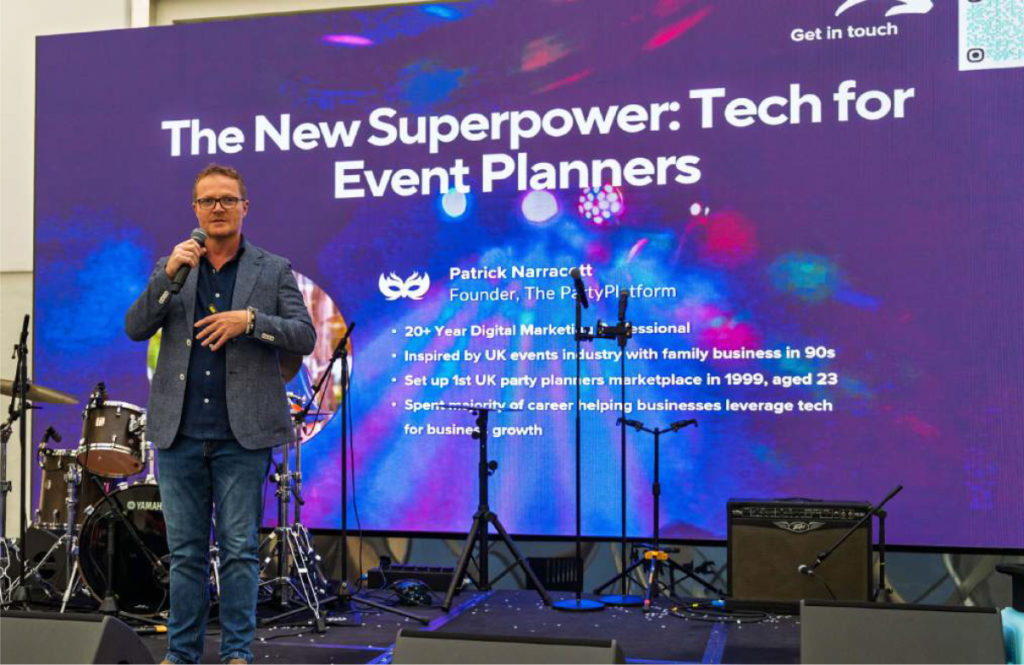

EventMag (EM): Patrick, welcome. Your background in the event industry goes back decades. Can you tell us what inspired you to shift your focus to technology and automation?
Patrick Narracott (PN): Thank you! It’s great to be here. My experience started way back in the late 1990s, working in my dad’s business on high-end events in London. That experience truly inspired me to get involved in the event industry. I set up the first online marketplace in the UK in the late 1990s. Since then, I’ve focused on helping businesses leverage technology to improve the customer experience and boost their overall sales.
EM: You started your presentation by asking the audience how many channels they use to acquire customers -WhatsApp, Instagram, email – and many raised their hands for “all of those”. Why is managing these multiple channels such a headache for event professionals?
PN: The fragmentation leads to chaos and anxiety. When you’re constantly bouncing between Excel, WhatsApp, Instagram, and email, it’s easy to lose a lead or forget to follow up. My main takeaway for everyone is learning how to implement a simple tool to free up your time and take away all the admin.
EM: You highlight three key features we need to focus on today: CRM, AI/Chatbots, and Automation. Let’s start with the CRM. How does this “brain in a box” revolutionize operations?
PN: A CRM, or Customer Relationship Management system, is exactly that – a brain in a box. It’s about working smarter, not harder. It allows you to keep everything in one place.
With a CRM, you can connect it to all your acquisition channels – your email, WhatsApp, and Instagram – so that all inquiries come into one single inbox. This eliminates the need to manage many different apps. At any time, you can see at a glance where every lead is, where every customer is, and where they are in the life cycle, whether they are a new sale, pending payment, or booked.
EM: You demonstrated how helpful segmentation is within the CRM.
PN: Absolutely. Once a customer is in your CRM, it’s useful to segment them using tags. You might tag a customer who needs attention as “VIP,” or differentiate between “business” and “private” customers. This keeps everything organized. Crucially, you can communicate back and forth via email, WhatsApp, or Instagram directly from the CRM tool, keeping all contact details, notes from phone calls, and documents in one place.
EM: Moving on to AI. How can a small or mid-sized events business effectively utilize chatbots?
PN: Think of an AI chatbot as a virtual team member who never sleeps, working at a fraction of the cost. If you’re constantly answering the same questions across WhatsApp, email, and Instagram, the chatbot can handle this for you. They can be very well trained with the information you provide.
Beyond answering FAQs, they can look at your calendar, check availability, and schedule appointments with customers. They also have huge potential for capturing and replying to customer feedback. Deploying an AI chatbot on your website will show instant results. If the chatbot can’t answer a query, it can defer it to one of your human team members.
EM: Finally, you called automation “your superpower”. How do we use automation to improve the booking process?
 PN: Automation is where you set the rules and let the technology run, ensuring every customer is followed up on time. For example, if you send an invoice for a deposit and the customer hasn’t paid, automation will track that and follow up repeatedly until they pay. It’s also crucial for post-event processes. As soon as an event is complete, automation can trigger a request for the customer to leave a review on your Google profile, which is important for your Google ranking. Automation, combined with a CRM and AI, frees up your time to allow you to concentrate on what you do best and potentially make more money.
EM: What is the main takeaway you want event planners to focus on today regarding technology?
PN: This is all about turning conversations into bookings. When you correctly implement AI and chatbots on your website, that website becomes a money-making machine. It’s the start of a funnel: you attract the right traffic through Google or Meta advertising, the traffic enters your chatbot, moves into your CRM, and then you let the technology do the rest of the work.





