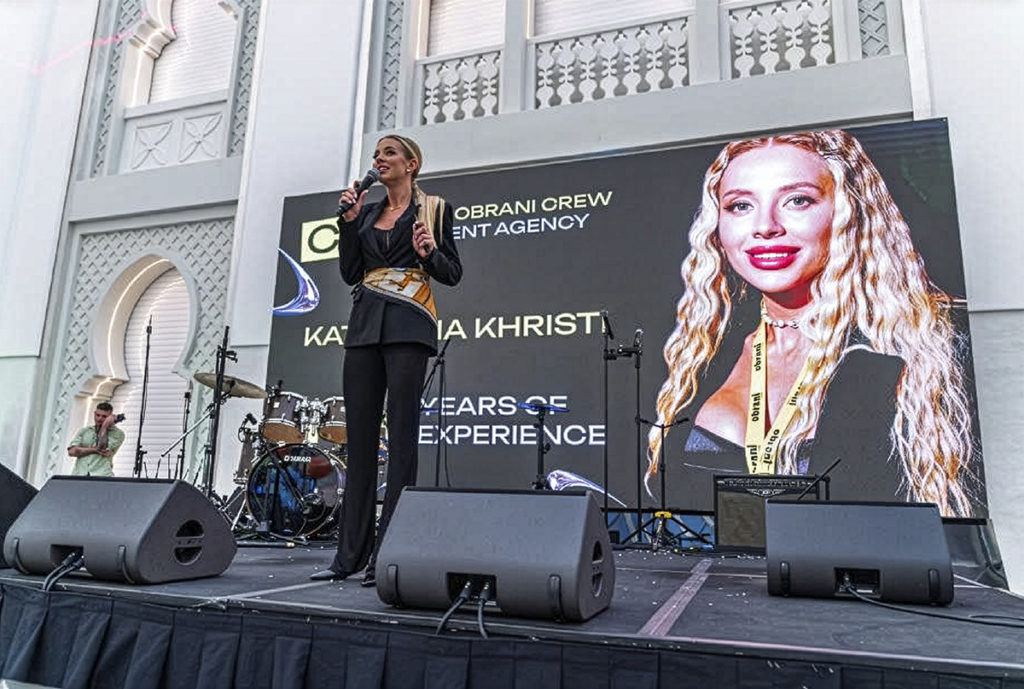

EventMag (EM): Welcome, Kateryna. As the Owner and CEO of your event agency, you’ve clearly seen significant growth in the market. Could you start by giving us a brief overview of your agency’s scope and focus?
Kateryna Khristi (KK): Thank you. I started working as an event manager in an event agency company about ten years ago, and then I opened my own agency. Six years ago, we were handling only about six projects per month. Today, our business is predominantly corporate, making up 80% of our clientele, while private clients account for the remaining 20%. We handle a wide variety of events, including corporate events, private parties, after-parties, and exhibition stands, depending entirely on the client’s request.
EM: You emphasize the importance of preparation before even meeting a client. In the age of digital communication, why do you advise against just sending out a standard briefing form?
KK: In my experience, it is much better to prioritize an online or offline meeting rather than sending forms or tables to clients. The most crucial step is to study your client before the first meeting. This preparation should cover the company’s history, the events they have held previously, and details about their future
customers and how many employees they have.
EM: What is the practical output of this deep pre-meeting research?
KK: This preparation results in two main internal documents. The first is a client report, which includes all the main information about the future customer. The second is a database, where we include all relevant links for that future client.
When you have this information before the first meeting, you can spend more time discussing the future project rather than asking basic questions like, “Please tell me about your company or history?”.
EM: Moving to commercial proposals, how do you ensure your pitch stands out? What role does visualization play?
KK: We use two main documents within our commercial proposal. For an event proposal, we believe you must include a wow effect. In our agency, we achieve this by adding visualization. For example, we show the client an empty location and then overlay the visualization of how the proposed event will look in
that space. We find this approach to be a very effective wow factor for increasing future sales. We also create a big presentation for each future client, which can include up to 100 slides per one commercial offer. If you are proposing specific detailed elements, such as a photo zone or stage, it is best to send only a few
options, rather than only one.
EM: A key piece of advice you gave was: “Don’t sell the event, sell the result.” Can you explain what event organizers should be focusing on instead of just the logistical details?
KK: Clients do not need the event itself; they need what the event will achieve. You should sell the result for your client. For instance, if a client wants to hold a conference, you should explain to them that the result will be about generating new leads. If the event is a gala dinner for their company or future brand, you must explain that the result is about brand awareness, media content, sharing, and posting.
EM: That focus on results sounds complex, especially in the corporate world. What kind of timelines are standard for closing a deal with a corporate client?
KK: In the event market, we generally don’t have direct sales numbers; we pay attention to the closed deal.
For service agreements with corporate clients, we spend anywhere from two to twelve months working on the deal. This requires building a long sales strategy. Furthermore, the work needed to create the commercial offer is extensive; our team spends more than 40 hours on each proposal for a corporation.
EM: Finally, you touched upon personal branding. For event professionals, what is the right balance between showcasing one’s personal life versus the business itself on social media?
KK: If you are building a personal brand, you should use your social media to tell people about yourself— your hobby, your passion, your family, and your emotion—not primarily about your business. This is because people follow people, they do not follow corporate brands. Conversely, when you create a corporate page, that is the appropriate place to share more cases about your successful events.
EM: Kateryna, thank you for sharing your insights.
KK: You’re welcome! And for anyone interested in collaboration, we do offer an agency commission structure if you recommend clients who need event services, with commissions starting from 5,000 dirhams.