


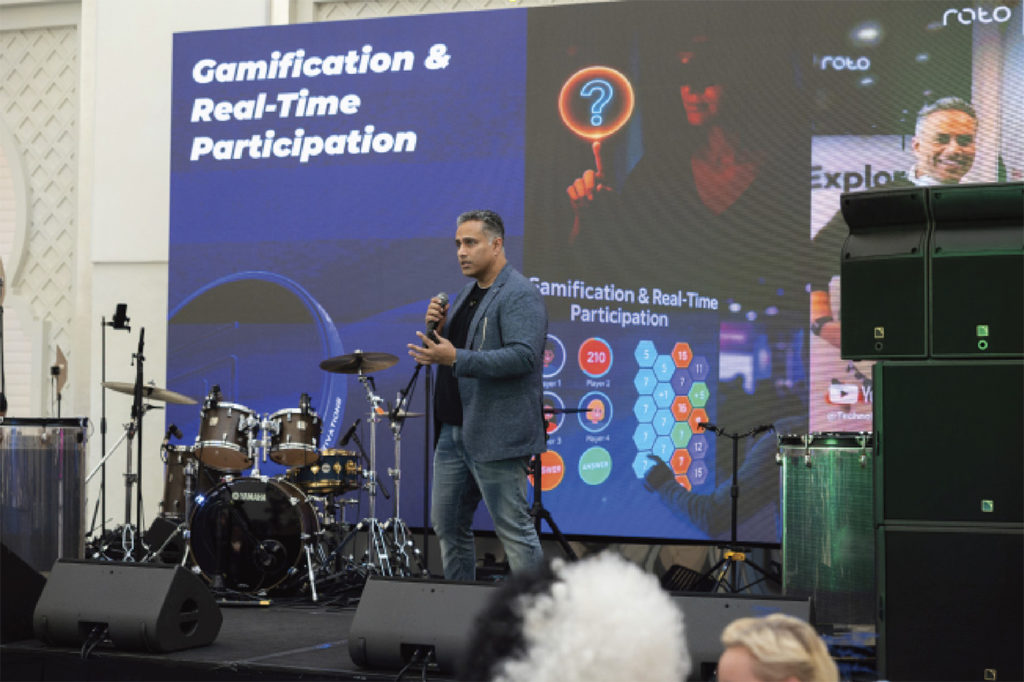

EventMag (EM): Mr. Cherian, with your three decades of experience in the tech space, you’ve seen firsthand how technology and entertainment are converging. What is the fundamental shift you are currently observing in the industry?
Sujoy Cherian (SC): I’m seeing a significant blending of technology and entertainment, particularly with the integration of AI. This passion has driven me to focus on how we understand our audience today, which is a major component in deciding what content goes into events and ensuring a high level of engagement. We are moving from the physical era into the age of the digital, which necessitates blending the physical world with the digital world.
EM: That blending seems critical, especially when considering audience attention spans. How have the latest generations changed the dynamics of engagement?
SC: The transformation is quite radical. Today’s generation is digitally native; they would expect everything to be digital, from physical phones to physical call sheets at events. However, this new digital landscape brings a big drop in attention span. Today, we face a scenario where approximately 100% of the audience has been lost in 20 minutes, resulting in an engagement ratio of about 20%.
If we are designing content or entertainment, we must make sure we engage the audience on a whole new level if we want a high retention of attention. Until the early 2000s, content communication relied primarily on audio and visual inputs, much like cinemas; you sat and watched because there was no distraction. That has completely changed.
EM: So, how do event designers and content curators address this engagement challenge? What new approach is needed?
SC: We need to jump into an age of interactivity to engage a “third sense”. Engaging this third sense is when you start to secure the attention of your audience and achieve a higher retention rate. This means moving beyond standard audiovisual consumption to incorporate audiovisual plus haptic feedbacks plus sound with the effects of wind or etc., adding different layers of interactivity. This engagement prevents the audience from communicating with their personal devices and getting distracted, leading to a higher retention of knowledge.
EM: You often reference Extended Reality (XR). How does XR facilitate this necessary blending of worlds?
SC: Extended Reality is the overarching term that encompasses all of this—it is about extending reality between our physical world and our digital worlds. This includes terminologies like VR, MR, and the Metaverse. The blending happens using technology that gamifies the experience, and gamifying entertainment is going to be the game changer for our industry.
For example, we are seeing hardware evolve to overcome previous barriers like dizziness in VR. The roto chair, for instance, allows engagement in a VR space without the user feeling dizzy or losing balance, keeping them grounded but moving with their motion. We also see technologies like six degrees of freedom (six DOF), such as racing simulators, bringing gamified, fly-through experiences to the entertainment industry.
EM: Looking ahead, what role does Artificial Intelligence play in making events more predictive and personalized?
SC: AI introduces the age of the predictive and eventually autonomous event. The adoption rate of AI platforms has been incredibly rapid; for comparison, it took Netflix approximately nine years to reach 10 million users, whereas OpenAI’s ChatGPT reached that subscription level in just three days. The entertainment industry must take advantage of AI to capitalize on engagement and make experiences more personalized.
AI fundamentally changes how we stage our performances and content, moving from traditional methodology into the next phase: AI and mixed media. Beyond that, AI agents can be used to create a whole ecosystem.
EM: Can you give us a concrete example of how AI analyzes audience engagement during a live event?
 SC: One key example is sentiment analysis. Imagine having cameras in the venue – the technology is already available – to analyze faces without taking personal data. I could have a live data dashboard that tells me:
1. How many people are paying attention to the content.
2. How many people are happy based on facial reaction.
3. Demographic information, such as the male/female count and the average age group.
Furthermore, this live analysis can manage crowds by identifying “red zones” where places are becoming too busy. This data can be quickly pushed through NFCs and edge computing to divert people to less congested areas. The foundation for this tech stack is being set as cloud-based AI starts coming directly to personal devices, like the technology announced for the iPhone 16.
EM: Besides AI analysis, what are some of the most exciting mixed media technologies you foresee integrating into live events?
SC: We are seeing exciting tech that enhances mixed media performances. For instance, smart glass now allows fluid, real-time reactions and interaction in midair, much like the concepts seen in the movie Minority Report in 2002. These technologies can be used in opening acts, content delivery, or launch events.
Also, volumetrics are a great invention in the space of holograms. Holograms historically have always been based on illusion, but volumetrics have completely changed that game.
EM: To summarize, what is your key takeaway for the future of the events and entertainment industry?
SC: Moving forward, the engagement technology is going to completely blur lines between the physical world and the digital world. We need to start integrating AI, ride that wave as it arrives, and evolve with new technology in the market. Ultimately, we must achieve a synergy between technology, entertainment, and content creation.





