


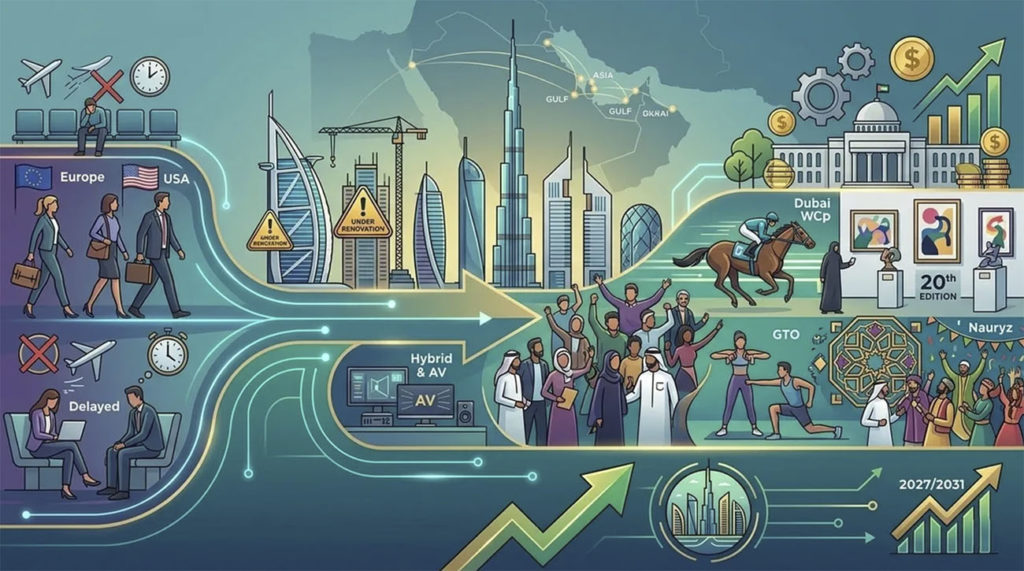

A key trend in April is the clear shift in the events market from international to local and regional focus. Western participants (especially from Europe and the USA) are massively declining or postponing participation, while regional (GCC), Asian, and local companies and audiences remain active. Bright examples include the successfully held Dubai World Cup, large-scale Nauryz celebrations, the first GTO fitness test outside Russia, and the upcoming special 20th edition of Art Dubai. Against this backdrop, several iconic hotels, including Burj Al Arab, have closed for renovation, taking advantage of the low-demand period. All this confirms that demand is “delayed, not lost,” and the long-term prospects for the MICE and events industry remain positive.
Short-term Challenges: Postponements, Logistics, and a Wave of Hotel Renovations
The geopolitical situation has led to widespread postponements of events. Conferences and exhibitions are being shifted several months ahead, with the impact on the industry expected to be felt until the end of 2026.
A clear example is AVIXA’s decision: the InfoComm EDGE event (planned for October 2026 at Festival Arena) has been moved to October 2027. Instead, an invite-only EDGE Preview will take place in Q4 2026 – a narrow working forum for key decision-makers.
The logistical shock is expected to outlast the conflict itself. Hotel occupancy in Dubai has dropped to 20%. Taking advantage of the downturn, several major hotels have closed for renovation:
- Burj Al Arab fully closed in mid-April 2026 for 18 months (until October 2027) – its first major renovation since opening in 1999.
- Park Hyatt Dubai (from May), Radisson Blu Dubai Media City, Armani Hotel Dubai, and others are also undergoing renovations.
In the corporate segment, CFOs are demanding strict ROI, ESG reporting, and compliance with new data protection laws. Hybrid formats have become the norm but require additional investment in AV technology.
Shift in Focus: From Global to Local and Regional
The events market in the GCC has clearly split “along passport lines.” Regional and local participants (from the UAE, Saudi Arabia, other Gulf countries, and Asia) show high activity and loyalty, while the Western corporate and incentive segment has significantly shrunk. This has led to the reorientation of many events toward local and regional audiences and stronger programs for Dubai residents and expats from friendly countries.
The Cultural Sector Demonstrates Resilience: Art Dubai’s Special 2026 Edition
A vivid example of adaptation is Art Dubai. The 20th anniversary edition was rescheduled and substantially reformatted:
- New dates: 15-17 May 2026 (VIP preview on 14 May) at Madinat Jumeirah.
- Format: Significantly scaled down – around 45-50 galleries (instead of 120+), with approximately 60% from Dubai and the GCC region.
- Key innovations: Risk-sharing model for stands, strengthened institutional program (Art Jameel, Sharjah Art Foundation, Dubai Collection), theme “things we do together”, performances, and site-specific works.
- At the same time, Alserkal Art Week has been extended to a full month (18 April – 18 May).
Benedetta Ghione, Executive Director of Art Dubai Group, emphasized the importance of the event right now – as a demonstration of the strength of local and regional cooperation.
Signs of Life: Events That Took Place
- Dubai World Cup was held as scheduled.
- Nauryz Celebration (19 April, BI Group): over 300 guests, a traditional yurt, Kazakh games, and the presence of the Ambassador of Kazakhstan.
- First GTO Fitness Test outside Russia (19 April, Dubai Sports City): more than 80 participants aged 6 to 57, over half received gold badges. Senior officials from the Russian and UAE sports ministries, the Russian Ambassador, and Consul General attended.
By April, more than 238 events and attractions across the GCC had resumed operations.
Government Support, Adaptation, and Forecast
The UAE government is offering support packages, summer RFPs, and tax incentives. Organizers predict an overloaded Q4 2026 and a strong recovery.
The events management market in the UAE is forecast to reach $2.62 billion by the end of 2026 and $3.58 billion by 2031 (CAGR 6.43%). Infrastructure development, Vision 2030/2031, and the legacy of Expo 2030 remain the main growth drivers.
Conclusion
The situation in the MICE and events industry of the UAE and GCC is a classic example of shock and resilience. Geopolitics is hitting hotel occupancy and international demand hard, while the closure of Burj Al Arab and other iconic venues adds extra pressure. However, the shift toward local and regional focus, along with events such as Art Dubai, Nauryz, GTO, and the Dubai World Cup, prove that the spirit of the industry and Dubai’s multinational character remain unshaken.
Those who invest now in technology, ESG, flexible formats, and work with regional audiences will win in 2027. “The show must go on” is not just a phrase – it is the current reality of Dubai.
Sources (all public links):
https://economymiddleeast.com/news/for-the-uae-events-industry-the-show-must-go-on/
https://ria.ru/20260419/gto-2087784330.html
https://www.instagram.com/reels/DXEskNnCW4q/
https://www.agbi.com/opinion/logistics/2026/04/shock-to-gulf-logistics-likely-to-outlast-conflict/
https://www.flaash.ae/blog/events/gcc-corporate-event-planning-trends-2026
https://ocula.com/magazine/art-news/art-dubai-presses-ahead-with-20th-anniversary/





