


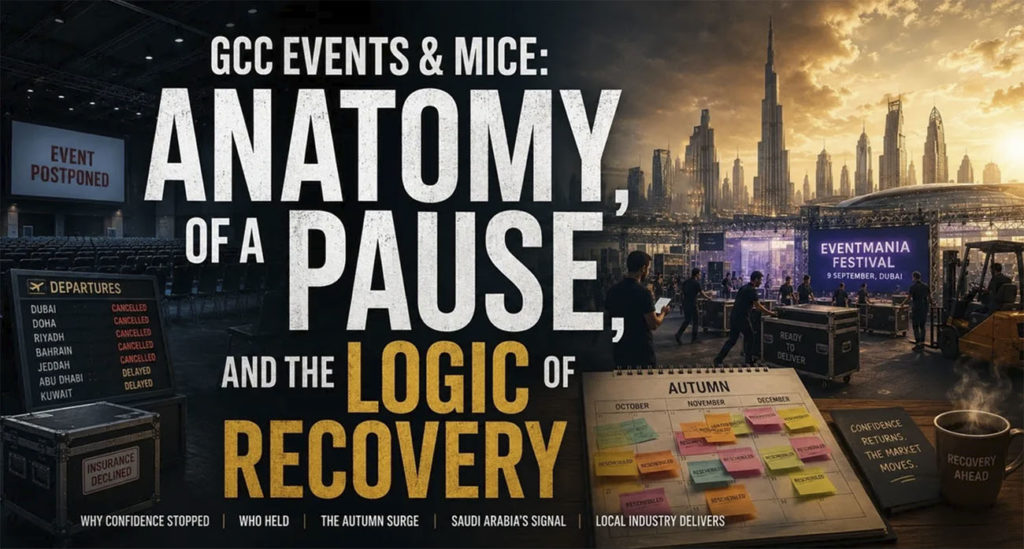

Why Things That Should Not Have Stopped, Stopped
When the skies above the region closed, conferences closed with them. Not metaphorically – literally. Participants could not fly in. Those already in the region were not sure they could fly out.Insurers refused to underwrite. Organisers were left without any shared operational picture.
That is precisely what Northbourne Advisory documented – the only organisation during thisperiod that was measuring rather than issuing statements. They tracked the fate of 275+ eventsacross the UAE, Qatar, Saudi Arabia, and Bahrain from late February through mid-April. Thepicture was precise: 99 events postponed or rescheduled, 45 cancelled outright, 29 left in limbo.
“Events didn’t stop because they couldn’t happen. They stopped because insurers wouldn’tunderwrite them, organisers didn’t have a shared operating picture, and internationalparticipants no longer had confidence to attend.” – Justin Kerr-Stevens, CEO, NorthbourneAdvisory.
Closed skies are a temporary condition. Confidence takes longer to rebuild.
Who Held
While international congresses went on pause, the regional segment held its ground. Corporateevents serving GCC audiences continued – business does not stop for geopolitics, it adapts.
This structural observation matters more than it might appear. It tells us the foundation of themarket is intact. The problem is not that business events stopped being relevant – the problemis that international audiences are not yet ready to travel. One is solved by time and safetysignals. The other would require rethinking the entire model.
Autumn: An Opportunity With Caveats
Of the events that have received new dates, 20 have already migrated to the October–December window. As the situation normalises, the rest will follow.
Tyler Davis-Smith of Energie Entertainment is direct about it: his company is deliberatelyholding its full team through the quiet period, banking on Q3–Q4. This is insider thinking, notanalysis – but it is telling. Those who understand the market are already positioning for anautumn surge.
Hassan El Kallini of Platinumlist adds a different angle: roughly 60% of major events soldthrough their platform have been postponed. When they all return at once – which is preciselywhat is now happening – the market will face a shortage of venues, contractors, and availabledates. Autumn will not simply be busy. It will be overheated.
The caveat matters: Platinumlist is a commercial platform, Energie is a market player. Both havean interest in an optimistic scenario. But the logic of overheating holds regardless of theirmotivation – the arithmetic of postponements speaks for itself.
Saudi Arabia: An Interesting Signal
This week RX announced the launch of WTM Spotlight Riyadh – a new dedicated MICE forumplanned for 8–10 September in Riyadh. The format is interesting: a platform designed to work inboth directions – showcasing Saudi Arabia to international planners, while simultaneouslygiving Saudi corporate buyers access to global destinations.
How real this turns out to be, time will tell. Infrastructure in the Kingdom is genuinely beingbuilt, investment in venues and hotels is real, Vision 2030 has not gone anywhere. But betweenthe forum announcement and actual international attendance stands the same confidence gapthat exists across the region right now. September will show.
While Some Announce, Others Deliver
While Saudi Arabia prepares for the debut of its MICE forum, Dubai will host EventMania Festival for the third consecutive year on 9 September – an industry gathering for the regionalevents market.
Modest by the standards of large congresses, but instructive: 300 participants in 2024, 400 in 2025, and this year an expansion to two parallel formats. Joining the core programme is WeddingMania – a dedicated stream for the wedding industry, in partnership with BrideClub.me. Thevenue is SkyLight Gallery at Arjaan by Rotana Dubai Media City, the same space as in previousyears.
The Event Maze format – structured speed-networking where up to 200 service providers rotatethrough 40 tables in three-minute bursts – remains the centrepiece. This is not a conferencespeaking from stage to audience. It is a working tool for people actively looking for contractorsand clients.
We are the media partner of this festival. And mention it here because it illustrates the pointmade above: local industry events in the region continue to function. No pauses, nopostponements, three years running.
The Russian Market as One Indicator
One of the more responsive gauges of market sentiment is the Russian tourist flow into the UAE.Russian travellers react quickly, and their behaviour is readable in real time.
On 15 May, Russia’s Ministry of Economic Development indicated that restrictions on tour salesto Middle Eastern countries could be lifted soon. Aeroflot has already opened bookings for Dubaiflights from 1 June. Tour operators are talking about recovery to 70–80% of pre-crisis volumes byearly autumn – though these are projections from people who very much want sales to resume,so apply the appropriate discount.
The real signal here is one: airlines do not open routes without demand. Which means part of theaudience is already ready to return. In summer – low season, with aggressive hotel pricing. Inautumn – a fuller recovery, if the situation stabilises.
Where We Stand
Demand is deferred, not lost. The skies are gradually reopening. The regional segment is alive.Autumn promises to be busy – possibly too busy for those who have not prepared ahead of time.
What is still missing for a genuine turnaround: sustained safety signals for internationalaudiences, the return of insurance coverage, and a handful of successful major events thatdemonstrate the region is back in business.
Until then – we are where we were. Waiting for good news.





