



There’s a simple test for how an industry is doing: who shows up when showing up is hard.
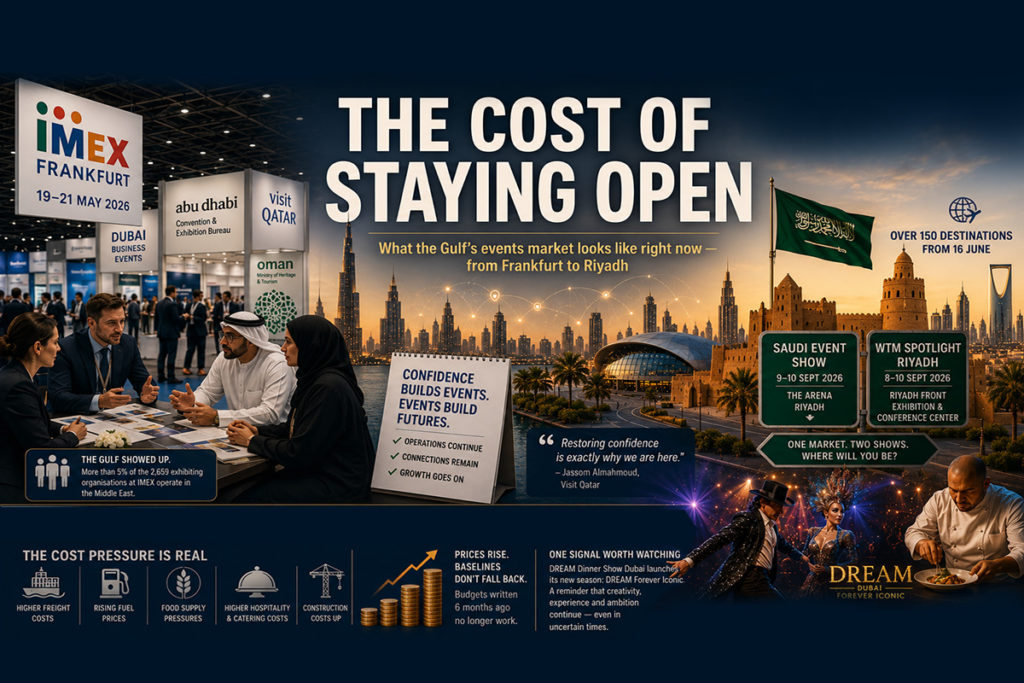
At IMEX Frankfurt (19–21 May 2026) – the world’s leading trade platform for the meetings industry – the Gulf showed up. All of it. Dubai Business Events brought a delegation of 20 co-exhibitors. Abu Dhabi came with a pavilion of around 22 partner companies. Visit Qatar held closed-door meetings with international organisers and met with ICCA about future conferences. Oman’s Ministry of Heritage & Tourism was on the floor. Saudi Arabia and Bahrain were present too.
More than 5% of the 2,659 exhibiting organisations at IMEX operate in the Middle East. In a year when the region has appeared in the news primarily as a zone of turbulence, that figure is itself a statement.
Why visibility matters more than ever
The context is not comfortable. Airspace disruptions, heightened security concerns and travel advisories linked to regional conflicts have affected sentiment and planning cycles. Organiser confidence has softened. Attendee confidence – a separate and harder problem – has softened further.
But exhibitors at Frankfurt were explicit about why they came anyway. “Business travel tends to be more resilient than leisure travel,” said Jasmine Lew, senior project head at Abu Dhabi Convention & Exhibition Bureau. “People still want to understand what opportunities exist and what business can be done.”
Abu Dhabi reported a 40% increase in MICE delegates to 2.2 million in 2025 over the previous year. The CVB’s presence at IMEX Frankfurt was partly about protecting that momentum – and partly about a more operational task: working with organisers on rescheduling. Postponed events, Lew noted, are significantly outweighing outright cancellations. The bureau has been actively intervening to negotiate more flexible contracts between organisers and venues. “Let’s be considerate. This is a mutual situation. It’s not the first time organisers and venues have been in a similar fix,” she said, drawing on lessons from COVID-19.
Visit Qatar was equally direct about its purpose in Frankfurt. “Restoring confidence is exactly why we are here,” said Jassom Almahmoud, PR and communications director at Visit Qatar. “We want to show the industry that operations continue, that Qatar remains connected to the world, and that we are still planning for growth.” Qatar Airways has announced expansion to over 150 destinations from 16 June. Exhibitions are running in Doha. Signed events – AIIB Annual Meeting, ITU Plenipotentiary Conference, Web Summit Qatar 2027, INTERPOL General Assembly 2027 – are already in the calendar. Qatar’s position at IMEX wasn’t aspirational. It was evidentiary.
Saudi Arabia: both destination and market
While Dubai and Abu Dhabi are managing the present, Saudi Arabia is building the future – and not only as a MICE destination, but as an events industry market in its own right. That distinction matters.
This autumn, two major players will compete for the same audience in Riyadh on the same days. Saudi Event Show, organised by Informa Connect, runs 9–10 September at The Arena. WTM Spotlight Riyadh, organised by RX, launches 8–10 September at Riyadh Front Exhibition & Conference Center. Both target event organisers, suppliers and MICE professionals in the Saudi market. Both are positioning themselves as the defining industry platform in the Kingdom.
Saudi Event Show is Informa – an established event with history and local roots in the Saudi market. WTM Spotlight Riyadh is RX entering new territory under the global WTM brand. Whether the date overlap is a failure of coordination or a deliberate bet that the market is large enough for both is an open question. For Saudi organisers and suppliers, the practical consequence is a forced choice: where to go, where to buy floor space, whose audience is worth more.
The answer to that question, visible by late September, will say more about the real weight and ambitions of both players than any press release.
The cost problem nobody is advertising
There is a variable absent from every pavilion presentation but present in every budget conversation: the cost of doing business in the Gulf is rising, and rising in ways that will not reverse quickly.
Recent disruptions to regional trade routes and energy flows – particularly around the Strait of Hormuz, through which around one-fifth of global oil and LNG trade passes – have fed directly into freight costs, fuel prices and food supply chains. In a trade-dependent economy like Dubai’s, imported inflation moves rapidly through logistics, aviation, retail, food services and construction. Hospitality and restaurant pricing has strengthened as operators absorb higher operational costs.
The structural dynamic makes this particularly sticky: lower inflation does not mean lower prices. Once businesses adjust their pricing upward to reflect higher import, labour or logistics costs, those prices typically stabilise at a new baseline rather than reversing. For event organisers, this is not an abstract economic debate. It is a line in the budget. Catering costs are up. Venue operational costs are up. The calculations on proposals written six months ago no longer work.
One signal worth watching
Against this backdrop, DREAM Dinner Show Dubai has launched its new season: DREAM Forever Iconic. The production brings together the venue’s most celebrated performances – Le Cabaret du Cirque inspired by Michael Jackson, the immersive Games of Illusions, fan favourite The Peacock – combined with live music, cinematic visuals and Chef Rifky’s Mediterranean-inspired dining.
A small news item. But for anyone tracking the health of Dubai’s premium entertainment and hospitality sector, it is a signal. High-end experiential venues are not retreating. They are programming. The corporate incentive market that feeds into venues like DREAM is still there – and still demanding quality.
What the autumn looks like
The GCC events calendar is now heavily concentrated in Q3–Q4. Events that slipped from spring are converging in a single window – creating scarcity in venues, suppliers, hotel blocks and available dates. Those planning now will have options. Those waiting for certainty will work with what is left.
What IMEX Frankfurt demonstrated is that the Gulf’s industry understands the assignment. Visibility when it is uncomfortable. Flexible contracts instead of cancellations. Evidence over aspiration. A region that has navigated COVID, post-pandemic volatility and now geopolitical turbulence is not treating 2026 as an anomaly. It is treating it as another test.
The autumn calendar is the next answer. And in Riyadh this September, there will be more than one.
Sources:
https://www.ttnworldwide.com/ArticleTTN/462924/saudi-arabia-targets-$565-billion-mice-market-
https://www.ttnworldwide.com/ArticleTTN/462929/dream-dinner-show
https://informaconnect.com/saudi-event-show/plan-your-visit/





