


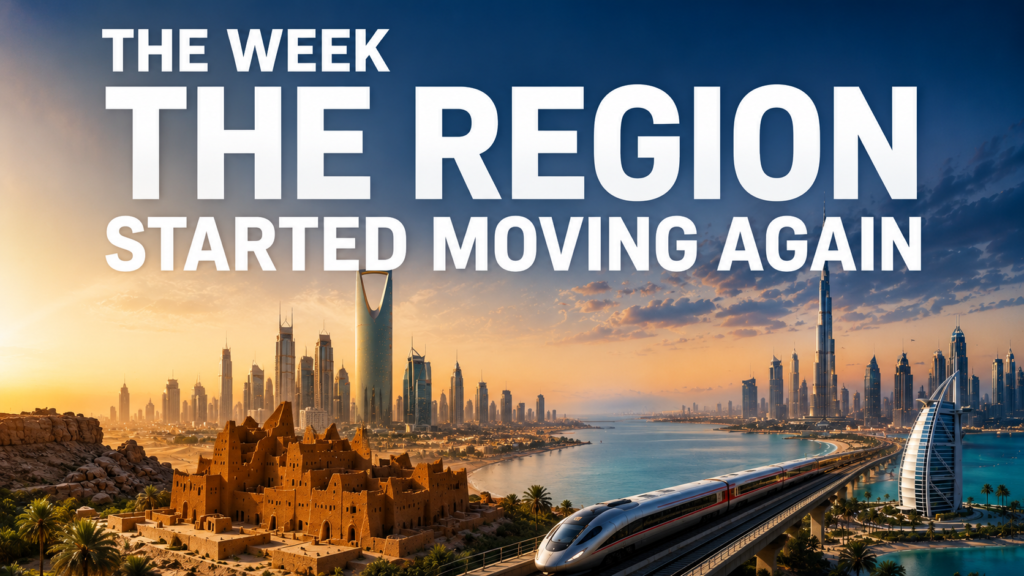

Three months after the conflict began, the GCC events and hospitality industry entered its most consequential week since February. Not because a single announcement changed everything – but because several things moved at once, in the same direction: toward recovery, investment, and a reopened season.
The signals came from Riyadh, Dubai, Paris, and the rails between the emirates. Together they describe a market recalibrating – not waiting.
Saudi Arabia: $22 Billion in Q1, Domestic Travel as the Foundation
The data arrived on the sidelines of the Future Hospitality Summit and landed as the clearest read yet on how the Kingdom’s tourism sector weathered the conflict. Cavendish Maxwell’s Q1 2026 hospitality report: SAR 82.7 billion ($22 billion) in tourism spending, 37.2 million visitors, growth of 8 percent year on year – despite a 13 percent drop in international arrivals.
The story inside the numbers is the one that matters for events and hospitality planning. Domestic tourists rose 16 percent to 29 million, accounting for 78 percent of all visitors. International travellers, however, generated nearly 60 percent of all spending from just 22 percent of arrivals – a ratio that reflects a rapid shift toward premium, high-spend inbound demand. The average international visitor spent more in Q1 2026 than a year earlier, even as fewer came.
Religious tourism drove the bulk of that performance. Makkah recorded occupancy of nearly 84 percent in January; Madinah reached 85 percent. The national average daily rate climbed 12 percent year-on-year to SAR 825. Saudi Arabia’s hospitality sector did not collapse under the conflict. It absorbed it through structural demand – pilgrimage, domestic travel, and a rapidly maturing corporate events ecosystem that did not depend entirely on international footfall.
FHS Saudi Arabia: Where Opportunity Meets Capital – and Asks Hard Questions
The Future Hospitality Summit Saudi Arabia (22–24 June, Mandarin Oriental Al Faisaliah, Riyadh) closed this week as the region’s first major post-conflict institutional gathering. What the room produced was not just deal flow – it was a recalibrated conversation about what hospitality investment in the Kingdom actually requires now.
Mahmoud Abdulhadi, Deputy Minister of Tourism Destinations Enablement, was direct: investors are asking sharp questions about returns, phasing, and stability. The answer, he said, lies in a diversified national portfolio – coastal, heritage, leisure, entertainment, sports, business – rather than reliance on any single project or market. Tourism’s share of Saudi GDP crossed 5 percent in Q1 2026, a milestone the Ministry described as structural rather than cyclical.
The numbers backing that case: 200,000 hotel keys in the pipeline to 2030, more than 50 global hotel brands in the Kingdom since 2020, and 50 percent of the tourism project pipeline now privately funded. Riyadh Expo 2030 and the FIFA World Cup 2034 remain the anchors for long-term demand – two events that between them are forecast to attract 42 million visitors combined.
On the sidelines of the Summit, Rotana confirmed a 10-property pipeline of 1,314 keys and a target of 23 hotels across Saudi Arabia by 2027. The group also signed a strategic MOU with the Saudi Tourism Authority covering co-marketing initiatives, loyalty programme synergies, and coordinated global outreach. Shaza Hotels announced a luxury equestrian resort in Al Jubailah, Riyadh – 63,500 square metres, designed as a fully integrated lifestyle destination tied to Saudi Arabia’s cultural heritage.
Saudi AI Tourism Vision: TourismX and the Infrastructure of the Next Phase
On the final day of the week, Saudi Arabia’s Ministry of Tourism unveiled its AI Tourism Vision – a strategic initiative launching TourismX, a global AI platform designed to function as the digital infrastructure layer for the Kingdom’s entire tourism industry. The announcement coincides with Saudi Arabia’s Year of AI 2026.
Minister Ahmed Al-Khateeb framed it directly: artificial intelligence is now reshaping how destinations are discovered, how experiences are designed, and how tourism services are managed. TourismX is not a booking engine or a consumer app. It is the backend infrastructure – connecting investor data, destination intelligence, operational systems, and visitor-facing services into a single platform. For the events and MICE sector, the implication is significant: Saudi Arabia is building the data layer that will power its conventions, exhibitions, and incentive travel programmes for the next decade.
UAE: Recovery Begins with a Signature and a Rail Ticket
Two developments this week gave the UAE hospitality and events sector its clearest forward signal since the conflict began. The first was the UK government’s decision to remove the UAE from its travel advisory list – a direct consequence of the US-Iran memorandum signed on June 17. Australia followed. Within hours, tour operators reported a surge in enquiry volume. Travel Dubai’s managing director described the situation as ‘busy, busy, busy.’ More than 1.4 million Britons visited Dubai in 2025; that pipeline had been effectively frozen. It is now reopening.
Chief executives at Accor, Rotana, and Leva offered the first public recovery forecasts on June 23. The consensus: initial recovery will be driven by regional and short-haul markets. Corporate and long-haul demand will rebuild more gradually through autumn and winter. A revitalised conference season – with the density of rescheduled events now compressed into Q3 and Q4 – is expected to be a primary driver. British Airways has indicated an October return; Virgin Atlantic is targeting winter 2026. The full recovery of premium international demand is a late-2026 story, with 2027 expected to see a return to pre-conflict levels.
The second signal was structural. On June 23, Etihad Rail confirmed that its first passenger service between Abu Dhabi and Fujairah would begin on June 30 – today. The Mohammed bin Zayed City station was inaugurated by Crown Prince Sheikh Khalid. Journey time: one hour and 45 minutes. Fares from AED 55. Dubai connects on September 30. The network completes with Sharjah in March 2027. For the MICE sector, the rail network redraws the geography of UAE event logistics – Abu Dhabi delegates reach Fujairah in under two hours; corporate groups can design multi-emirate programmes around fixed, predictable journey times rather than road transfers. Fujairah’s hotels are already planning shuttle services from the station.
EPEX 2026: Dubai Hosts the Season Opener for MICE Recovery
Experiential Planner Expo (EPEX) 2026 confirmed its return to Dubai on 2–3 September, with Dubai Business Events continuing as Host Destination Partner and Kerzner International joining as Headline Partner. The theme – ‘Where Leaders Reconnect’ – is precisely timed: September is when the events industry’s annual planning and contracting cycle begins, and 2026’s compressed autumn calendar makes it the most commercially significant September the region has seen in years.
EPEX connects over 100 senior hosted buyers from India, the Middle East, Africa, and emerging outbound markets with destinations, hotels, venues, and experiential stakeholders. Kerzner’s arrival as Headline Partner carries weight beyond branding: the company appointed its first-ever Global Director of MICE this month – Natalie Slavikova, 15 years of luxury hospitality experience across Dubai, London, Frankfurt, and Prague. The role did not previously exist. Its creation signals that luxury hospitality groups are now structuring specifically for the MICE segment, not treating it as overflow from leisure.
Vision Golfe 2026: France and the GCC at Scale
On June 18–19 in Paris, Vision Golfe 2026 convened more than 1,200 participants – five ministers, senior officials, and business executives from France and all six GCC member states. Organised by Business France, the forum featured 13 high-level panel discussions, 80+ speakers, and over 3,500 B2B meetings across two days.
For the events and MICE industry, the signal is less about the bilateral relationship itself and more about the format and the moment. A 3,500-meeting forum in 48 hours, with government ministers on stage and institutional investors in the room, is itself a statement about what high-value business events deliver that digital channels cannot. And it happened during the week that UAE and Saudi Arabia were both consolidating their own investment narratives – meaning that capital now flowing between France and the Gulf will need platforms, venues, and event infrastructure to close in.
Ruggieri × Novara Events: European Expertise Enters GCC Live Events
Ruggieri – a French pyrotechnic company founded in 1739, with 300 years of experience in fireworks, special effects, and multimedia productions – announced a project-based collaboration with Novara Events Management to bring high-end live experience design to the GCC. The partnership targets the $120 billion GCC events industry with a specific focus on innovation that has not previously been available in the region at this technical level.
The timing is deliberate. As the region’s events calendar rebuilds for H2 2026 and beyond, production companies and live experience vendors are positioning for a pipeline of rescheduled and new major events. Ruggieri brings a legacy of Olympic ceremonies, royal events, and landmark cultural productions. Novara brings regional market access and operational infrastructure. Together, they are betting that the next chapter of GCC events will not just be bigger – it will be technically more ambitious than anything the region has produced before.
GCC Grand Tours Visa: One Permit, Six Countries
The GCC Grand Tours Visa entered its public rollout phase this week. The unified tourism permit allows international visitors to traverse all six GCC member states – UAE, Saudi Arabia, Qatar, Oman, Bahrain, and Kuwait – on a single electronic authorisation, effectively creating a Gulf equivalent of the European Schengen zone. The digital-first system processes applications through a centralised platform, eliminating individual visa requirements for each destination.
For the MICE sector, the implications are direct: international delegates attending a conference in Dubai can now extend into Riyadh, Doha, or Abu Dhabi without additional paperwork. Incentive travel designers can build multi-country GCC itineraries for the first time without managing six separate visa programmes. Corporate travel planners gain flexibility to route groups across the region based on event location, hotel availability, and destination preference rather than immigration logistics. The visa does not remove barriers entirely – full six-country rollout is expected to complete in late 2026 or early 2027 – but the public rollout phase marks the moment the concept became operational reality.
Sources
https://economymiddleeast.com/news/saudi-tourism-spending-hits-22-billion-as-domestic-travel-powers-sector-growth/
https://www.tradearabia.com/News/464003/Saudi-tourism-spend-hits-$22bn-in-Q1-2026
https://www.arabnews.com/node/2648243/business-economy
https://www.agbi.com/tourism/2026/06/investors-need-more-than-promises-says-saudi-minister/
https://mid-east.info/300-year-old-french-fireworks-experts-ruggieri-partners-with-novara-events-to-bring-innovative-experiences-that-will-boost-the-us120-bn-events-industry-in-the-gcc/
https://www.nomadlawyer.org/united-arab-emirates-joins-saudi-arabia-qatar-oman-bahrain-and-kuwait-in-historic-schengen-style-mobility-shift-as-the-gcc-grand-tours-visa-enters-public-rollout-phase-in-2026





