


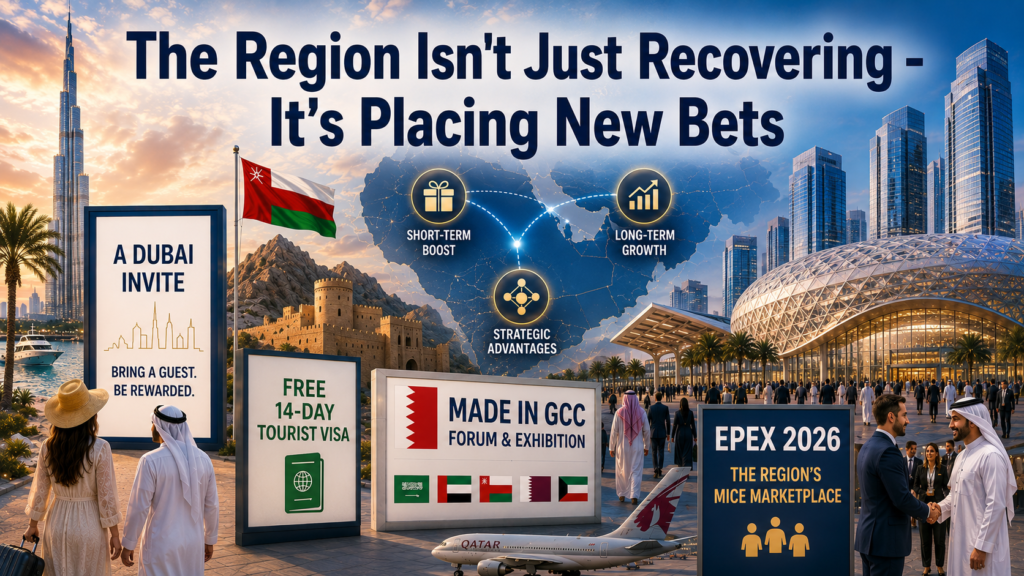

This week the Gulf’s events story split into two registers that ran side by side without cancelling each other out. One register is defensive: governments paying residents to fill hotel rooms, an airline-adjacent operator counting the cost of rescheduled shows. The other is offensive: Saudi Arabia and Bahrain both used the week to launch platforms that assume the region’s events economy has years of growth ahead of it, war or no war. Reading only one register would miss the point – both are happening in the same seven days, often in response to the same underlying uncertainty.
Paying for confidence, one visitor at a time
Dubai’s “A Dubai Invite” campaign, part of the Dh1.5bn stimulus package the emirate approved in May – which also suspended the Dh20 nightly hotel tax – drew more than 10,000 applications within 48 hours of launch, prompting Dubai’s Department of Economy and Tourism to review whether the reward cap needs raising. The National reported the scheme explicitly as support for a hospitality sector “hit hard by the challenges of the Iran war,” rewarding residents who bring overseas guests to the city between 20 July and 31 October. Oman moved in parallel: a Royal Oman Police decision published in the official gazette on 2 August introduced a free 14-day tourist visa for nationals of designated countries, extending a visa-liberalisation push that already grants visa-free entry to citizens of more than 100 countries. Neither measure waits for the war to end; both treat demand as something a government can manufacture in the meantime.
Same conflict, opposite ledger entries
The pattern that opened last week’s digest continued into this one. Informa PLC’s half-year results, reported 30 July, named “in-year events rescheduling within directly impacted conflict markets in IMEA” as a factor behind softer adjusted operating profit – a rare instance of a listed operator putting the war in writing as a line-item risk. GL events, meanwhile, used the same week to add a healthcare vertical to its Exhibitions division, the same division whose overall numbers had dropped 28% in its own half-year report a week earlier. The two moves are not contradictory so much as two different responses to identical uncertainty: one operator books the loss, the other keeps building inside it.
Saudi Arabia stops describing events and starts building infrastructure around them
Writing in Gulf Business on 30 July, Tahaluf chief executive Mike Champion made the clearest public case yet for how Riyadh thinks about its events sector: not as visibility spend, but as “market entry infrastructure” for foreign companies and a deliberate engine of economic diversification. Tahaluf – the joint venture between Informa, SAFCSP and the Events Investment Fund that runs LEAP – has expanded since 2022 into cybersecurity, fintech, real estate, healthcare and gaming, and Champion described the shift as the “festivalisation of business events”: platforms built less like grid-packed exhibition halls and more like town squares people choose to spend a day in. He pointed to Ejar, the Saudi proptech startup that secured a $400,000 investment at LEAP 2023 and returns to LEAP 2026 with a unicorn-branded booth, as the arc the model is designed to produce. The same week, Tahaluf put that logic into a new property: Cityscape West KSA, launching 29–31 March 2027 at the Jeddah Superdome under the sponsorship of the Ministry of Municipalities and Housing, extends the Cityscape Global platform – which generated $63bn in on-site transactions last year – into a Western Region where Jeddah residential values rose 28% and Madinah 49% year-on-year.
Bahrain claims a first of its own
The Kingdom of Bahrain announced on 25 July that it will host the inaugural Made in GCC Forum and Exhibition from 6–8 October at Exhibition World Bahrain, under the patronage of King Hamad bin Isa Al Khalifa and co-located with meetings of the GCC Industrial and Commercial Cooperation Committees. GCC Secretary-General Jasem Albudaiwi is confirmed to attend alongside ministers from across the bloc, and the event is explicitly framed as building “Made in GCC” into a unified industrial brand. The date is notable less for what it announces than for where it lands: directly inside the September–October window that last week’s digest flagged as an already-crowded bet on autumn recovery – Arabian Travel Market (14–17 September), WTM Spotlight Riyadh (8–10 September) and now a first-edition pan-GCC industrial forum a few weeks later. Bahrain isn’t waiting for that calendar to clear before claiming a slot in it.
Qatar picks a third path: neither stimulus nor launch, just durability
Where Dubai and Oman are buying short-term demand and Saudi Arabia and Bahrain are building new platforms, Qatar’s approach this week read as structural. A Gulf Times feature on 30 July framed Hamad International Airport not as background infrastructure but as “a marketing tool in its own right” – its connectivity to more than 190 destinations via 35 airlines, layered with Qatar Airways’ own network of over 160 destinations, is presented as the reason Doha can sustain a tourism calendar built for every season rather than a single peak, with the Qatar Games Festival cited as one deliberately off-peak fixture in that design.
The marketplace votes with its exhibitor list
One further data point from the same week came from the ground rather than from governments or operators: EPEX 2026, the region’s incentive and MICE sourcing show, confirmed 45 returning exhibitors plus 20 new ones for its next edition – among the new names Kerzner International, Wynn Al Marjan Island, Kempinski Muscat and The St Regis Al Mouj Muscat, alongside international destinations exhibiting for the first time, including One&Only Aesthesis in Greece, One&Only Portonovi in Montenegro, Mazagan Beach & Golf Resort in Morocco and Royal Livingstone Victoria Falls in Zambia. A sourcing show that buyers and suppliers choose to expand into new destinations, rather than shrink back to familiar ones, is its own kind of signal – buyers are still shopping, and more suppliers than before think it’s worth showing up.
None of this cancels the caution behind last week’s downgraded hospitality forecast or this week’s Informa numbers. But four governments picked four different instruments in the same seven days – Dubai’s cash incentive, Oman’s open door, Saudi Arabia and Bahrain’s new platforms, Qatar’s connectivity argument – and the marketplace itself kept growing underneath them. Not one of these actors chose to simply wait out the war.
On 16 September, EventMania brings its B2B speed-networking format to Doha for the first time, at the Marjan Ballroom, Swissôtel Corniche Park Towers, in partnership with MICE&MORE Magazine.
Sources
https://www.khaleejtimes.com/world/gulf/oman-new-free-tourist-visa-14-day
https://www.omanobserver.om/article/1193824/oman/rop/oman-introduces-a-new-free-14-day-tourist-visa
https://www.gulf-times.com/article/730167/business/qatar-builds-a-tourism-economy-designed-to-last-all-year
https://www.experientialplanner.com/industry-update/epex-2026-shapes-up-as-the-regions-most-diverse-marketplace-for-events-incentives-celebrations/
https://exhibitionnews.uk/gl-events-makes-addition-to-exhibitions-division-healthcare-vertical/





