



When we speak about the future of hospitality in the Middle East, the conversation often turns to artificial intelligence, digital transformation, new accommodation formats or sustainable tourism. Yet at the recent forum Water Security in Arid Regions: Innovations for Scarcity, Resilience & Sustainable Growth at Dubai Science Park, the focus was placed on something far more fundamental: water.
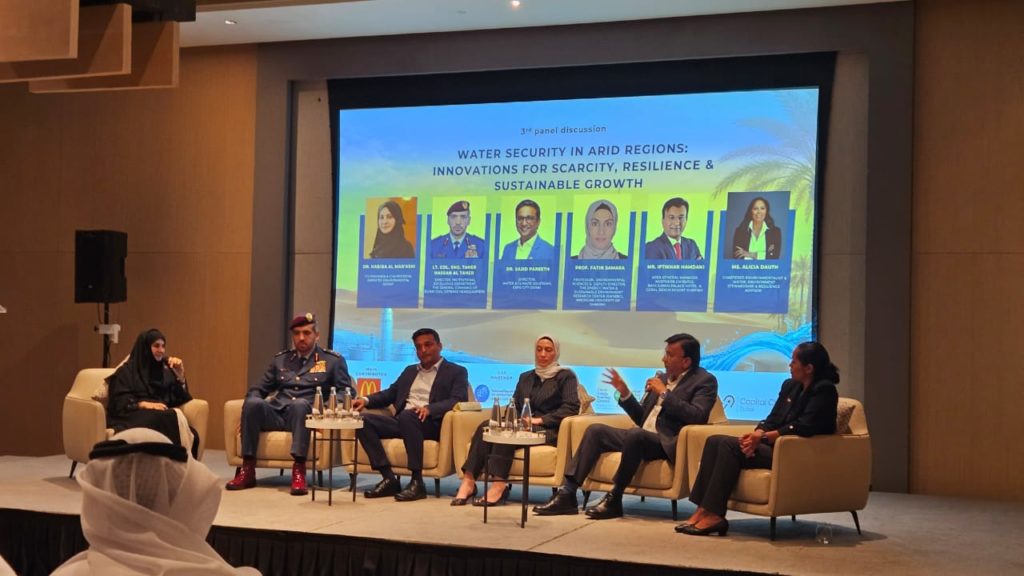
The forum opened with remarks by Dr. Habiba Al Mar’ashi, Co-Founder and Chairperson of Emirates Environmental Group (EEG), one of the most prominent figures in the UAE’s environmental movement. For more than three decades, she has been working across sustainability, corporate responsibility and environmental policy in the region.
Her opening remarks set the tone for the discussion: is producing more water enough to ensure water security?
For a region where over 90% of drinking water is produced through seawater desalination, water security is no longer only an environmental issue. It is also a question of economy, infrastructure, urban development, tourism and long-term business resilience.
One of the first presentations was delivered by Lt. Col. Eng. Taher Hassan Al Taher, Director of the Institutional Excellence Department at Dubai Civil Defence Headquarters. His presentation reminded the audience that water security is not only linked to environmental protection and sustainability, but also to public safety, urban infrastructure resilience and emergency preparedness.
For the fast-growing cities of the Middle East, water is no longer simply a utility. The operation of hotels, hospitals, industrial facilities and entire urban districts depends on its availability. This makes water management part of a much broader resilience strategy.
From Saving Water to Managing Water
One of the key messages of the forum was that the modern approach to water goes far beyond the familiar call to “use less”.
This perspective was explored by Dr. Sajid Pareeth, Director of Water & Climate Solutions at Terra, Expo City Dubai, whose presentation focused on the growing role of data, satellite monitoring and digital tools in water management.
Experts increasingly speak about the need to measure, analyse and manage water resources with the same discipline that companies apply to financial management.
A particularly interesting example was the UAE Water Accounting Platform, a digital initiative presented by experts from Terra, Expo City Dubai, aimed at improving the measurement and analysis of water resources. The topic is especially relevant for Expo City Dubai, where Terra serves as a pilot site for the principles of urban water accounting – an approach that helps track where water comes from, how it is used and where it can be reused.
In essence, this is a form of “water accounting”. Using satellite data, such systems can help analyse the water balance of territories, assess consumption, evaluate efficiency and provide an objective basis for decision-making at city and regional level.
If financial reporting helps us understand where money goes, water accounting helps us understand where water goes – a resource that has always held particular value in the Middle East.
Why Water Quality Is Becoming the Next Challenge
For many years, the main question for the Gulf region was the availability of water itself. Today, more attention is being given to its quality.
Professor Fatin Samara of the American University of Sharjah presented research on the UAE’s marine environment and on new types of pollutants increasingly found in aquatic ecosystems.
The discussion covered not only traditional pollutants, but also so-called emerging contaminants – substances whose impact on the environment and human health is still being studied. These include PFAS, often called “forever chemicals”, as well as microplastics, pharmaceutical residues and other compounds that can accumulate in the environment.
This is especially relevant for the Gulf region, where seawater becomes the primary source of drinking water after desalination.
Researchers presented not only monitoring results, but also new water treatment technologies, including innovative photocatalytic materials capable of breaking down pollutants directly in seawater.
The conclusion is clear: water security today is not only about the quantity of water available, but also about its quality.
When Innovation Leaves the Laboratory
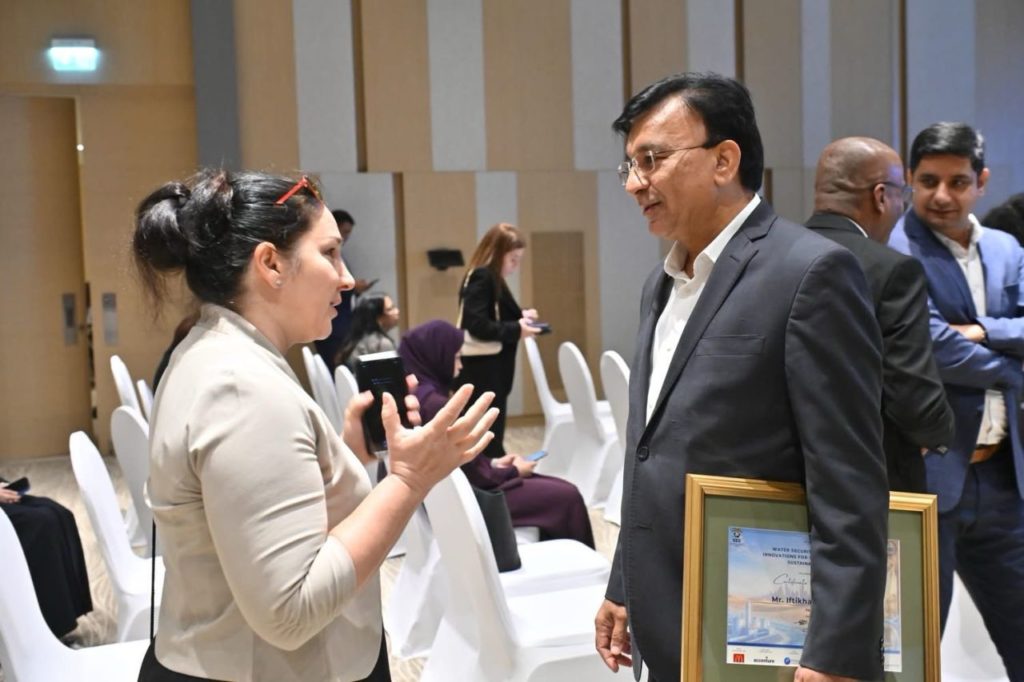
A practical perspective from the hospitality industry was presented by Mr. Iftikhar Hamdani, Area General Manager – Northern Emirates, Bahi Ajman Palace Hotel and Coral Beach Resort Sharjah.
His examples were particularly valuable because they were not theoretical ESG statements, but real solutions already implemented in operating hotels.
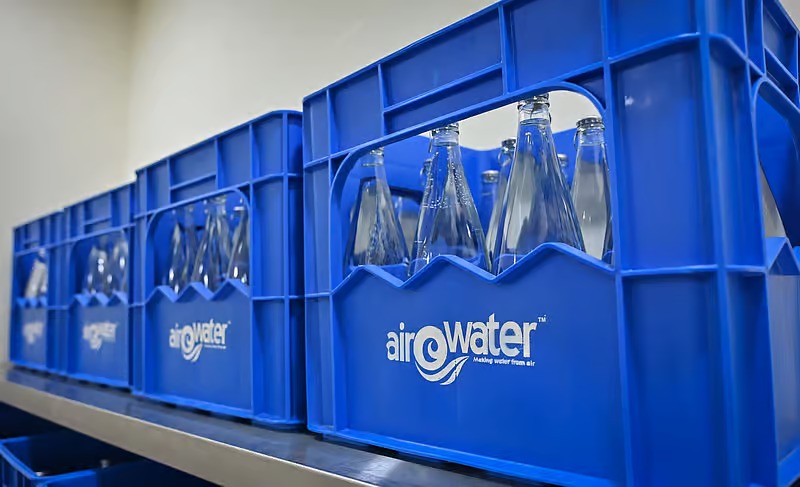
Among these initiatives are composting and a zero-landfill initiative in Ajman, a waste management system in Sharjah, an urban farm in Ajman, the installation of advanced water filtration technology in Sharjah in 2023, and the launch of air-to-water technology in Ajman in 2025 – a system that extracts moisture from the air and converts it into clean drinking water.
The system collects atmospheric moisture, purifies it and turns it into drinking water, which is then served to hotel guests in reusable glass bottles.
According to the speaker, many international colleagues are still surprised that such solutions are already being used in practice within the UAE hospitality sector.
Equally important is the fact that the project does not stop at installing equipment. Hotel staff are trained to explain the system to guests, turning a technical solution into part of the guest experience.
This example reflects an important trend: sustainability is increasingly becoming not only an internal operational matter, but also part of a hotel’s brand story.
Hospitality as Part of the Water Transformation
The hospitality industry has traditionally been one of the more resource-intensive sectors.
Water is used across guest rooms, laundries, swimming pools, landscaping, kitchens, spas and public areas.
As tourism grows and new hotel projects continue to develop across the region, efficient water management is becoming increasingly important.
This is why the forum addressed areas such as treated wastewater reuse, smart monitoring of water systems, early leak detection, water quality management, the use of artificial intelligence and satellite data, and the integration of climate risks into infrastructure planning.
The corporate responsibility perspective was further explored by Alicia Dauth, Chartered Environmentalist and Water Stewardship Advisor. She introduced the concept of Water Stewardship – an approach that encourages companies to view water not only as a resource within their own properties, but as part of a wider ecosystem.
It is not simply about saving water. It is about collaboration between businesses, local communities and public institutions to manage water resources more responsibly and sustainably.
The Future of Water Security
Only a few years ago, sustainability was still seen by many as an optional add-on.
Today, ESG performance, carbon footprint and resource efficiency are becoming part of corporate strategy.
Water security appears to be following a similar path.
While the focus in the past was mainly on building additional desalination capacity, the conversation is now shifting towards integrated water management, water quality, monitoring, reuse and infrastructure resilience.
For the Middle East, this is not just an environmental agenda.
It is a question of long-term competitiveness for cities, businesses and the hospitality industry.
That is why the conversation about water increasingly resembles the conversation about finance: to manage a resource effectively, we first need to measure it, understand it and account for it.
Water, in other words, is gradually becoming one of the key currencies of the future.





