


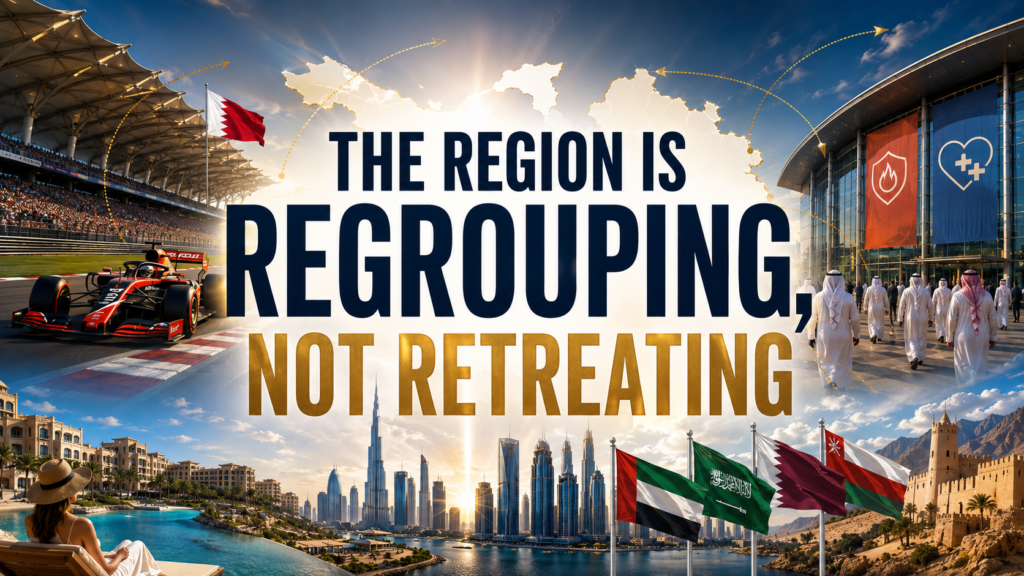

This week produced no single headline an editor could lead with – a Formula 1 race changing continents, a French exhibition group’s half-year numbers, a record tourism release from one of the Gulf’s smaller emirates. Read separately, none of it says much. Read together, it traces the same shift: capital and events aren’t leaving the Gulf, they’re redistributing inside it – away from the marquee international calendar and toward whichever address, category or investor is still willing to show up.
A flagship changes address, not name
Formula 1 and the FIA confirmed this week that the 2026 Bahrain Grand Prix will be held not in Bahrain but at the Sepang International Circuit in Malaysia, from 2-4 October, under an agreement between F1, the FIA and the governments of both countries. The race keeps its Bahrain identity – it will run as the “Formula 1 Gulf Air Bahrain Grand Prix in Malaysia” – while organisers considered and rejected alternatives including a second Las Vegas weekend and a return to Barcelona. It is the clearest single image of this stage of the crisis: a flagship Gulf event choosing exile over cancellation, and finding a host willing to lend it a track rather than let the calendar shrink.
Global operators lose ground, local ones pick up new mandates
GL Events reported first-half 2026 results this week that its CEO described as maintaining overall momentum “notwithstanding our footprint in the Middle East” – code for the fact that the group’s Exhibitions division dropped 28% even as its Venues and Live divisions grew on the back of the Stade de France integration. At the same time, IEG Arabia – the Saudi subsidiary of Italian Exhibition Group – announced it had secured the right to organise two new trade fairs, a Fire & Safety Expo and a Health & Wellness Expo, at Dhahran Expo in November, tied to the World Firefighters Games. IEG’s regional CEO framed it explicitly as expansion tied to Vision 2030 priorities. Same conflict, same quarter, opposite bets: the international group is absorbing a Middle East drag on its numbers while a locally rooted subsidiary of the same industry is adding mandates.
Recovery moves another quarter out
S&P Global Ratings pushed its expectation for the start of Gulf hospitality recovery to the fourth quarter of 2026, with pre-war occupancy levels not likely before the end of 2027 – an assessment carried this week by Zawya. Dubai occupancy fell from 84.7% in February to roughly 33% in March; about 5,400 hotel rooms have been pulled from the Dubai market for refurbishment while operators wait out demand. S&P names the meetings, incentives, conferences and exhibitions segment specifically among the exposures that would deepen if the conflict drags on. The divergence is regional: Saudi Arabia has been comparatively insulated because Umrah and Hajj flows kept hotels running, while Oman has picked up leisure demand diverted away from the UAE.
Domestic demand is covering what international demand can’t
Ras Al Khaimah welcomed more than 670,000 visitors in the first half of 2026 – its strongest first-half performance on record – with domestic arrivals up 47% year on year and May its busiest month ever, according to RAKTDA. The pipeline keeps building regardless: Rotana Ras Al Khaimah – The Mangroves opens in Q3 with new MICE facilities alongside its 258 rooms. In Oman, Dhofar Governorate is advancing 36 tourism and hospitality projects, 23 of them already under construction, ahead of the Khareef season – on top of the 123 licensed hotels and 8,400-plus rooms it already operates. Neither market is offsetting the international shortfall the region-wide numbers describe; both are proof that the shortfall is being managed locally rather than left to sit.
Capital hasn’t left, it’s changed passports
MENA startups raised $1.35 billion in the first half of 2026, down 22% year on year, with deal count falling 41% to the weakest first-half total in at least five years, according to Magnitt data reported by AGBI. But the composition shifted more than the total: international investor participation nearly halved, from 181 investors to 95, while Gulf-based investors raised their share of capital deployed to more than 80% – a five-year high of $940 million. The same substitution shows up outside finance: Arab visitor arrivals to Syria doubled in the first half of the year even as overall international arrivals there surged sixfold, with GCC travellers among the fastest-growing source markets. In both cases, regional actors are filling space that international ones have vacated, not replacing lost volume so much as changing who supplies it.
None of these seven items alone changes what the industry already knows: recovery is slower and further out than anyone hoped in February. But together they show where the compensating mechanism actually sits – not in a single ceasefire headline, but in whichever domestic visitor, regional investor or locally headquartered organiser is still willing to place a bet the international market currently won’t.
Sources
https://exhibitionnews.uk/gl-events-overal-h1-results-maintain-momentum-although-exhibitions-division-numbers-drop-28/
https://exhibitionnews.uk/arabian-action-stations-ieg-to-organise-two-new-expos/
https://en.wikipedia.org/wiki/2026_Bahrain_Grand_Prix
https://www.planetf1.com/news/bahrain-grand-prix-malaysia-sepang-confirmed-replacement-venue
https://www.zawya.com/en/business/gulf-hospitality-sector-recovery-to-begin-in-q4-but-likely-gradual-405482
https://travel.economictimes.indiatimes.com/news/destination/global/ras-al-khaimah-records-highest-ever-h1-visitor-arrivals-as-tourism-pipeline-gathers-pace/132601684
https://www.c-mw.net/omans-dhofar-governorate-plans-tourism-and-hospitality-expansion/
https://www.agbi.com/analysis/banking-finance/2026/07/gulf-capital-cushions-mena-startups-but-tougher-test-looms/
https://www.agbi.com/tourism/2026/07/arab-visitors-double-as-syrias-tourism-draws-global-attention/





