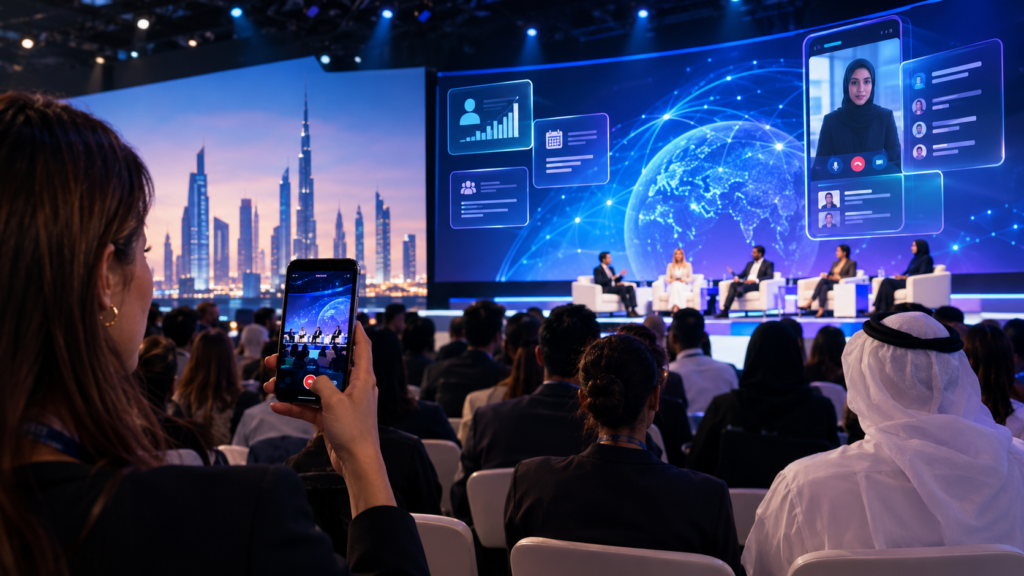

The global events industry has invested heavily in event technology over the past decade, but a subtle shift has been taking place over the last 5 years, globally. The concept is becoming more apparent in the GCC with the conversation moving beyond registration platforms, mobile apps and event management systems towards technologies that actively shape how audiences participate and engage during live experiences. Discussions on this topic at the world’s only dedicated expo, Event Tech Live as well as Informa’s Middle East Event Show and Saudi Event Show increasingly reflects this evolution.
This article covers what engagement technology is, how it can help improve audience engagement and offers a 5-step plan to create an Event Engagement Plan. But what is Engagement technology? Think of a collection of digital, immersive and AI-powered tools that encourage audiences to actively participate during a live event that influences behaviour, stimulates interaction and creates memorable shared experiences.
Participation Technologies: Giving Every Delegate a Voice
Today’s attendees expect to contribute rather than simply listen at conferences. Live polling, moderated Q&A, audience voting, collaborative whiteboards and gamification are transforming conferences into two-way conversations. Information flows from stage to conference audiences and meeting delegates and back to create dynamic conversations that improve engagement, knowledge sharing and attendee satisfaction. Slido is used widely in the Middle East. For example, Saudi’s renowned King Abdullah University of Science and Technology has incorporated Slido as default polling service within the KAUST Webex platform for meetings.
Breaking Language Barriers Through AI
International events increasingly attract multilingual audiences, making accessibility just as important as interaction. AI-powered translation platforms such as Wordly is regularly used by the Riyadh Exhibitions Company’s upcoming Saudi Agriculture expo and Saudi Build expo conferences, delivers real-time interpretation in 67 languages. This enables their international conference audience to participate confidently from their phones regardless of their native language. Multilingual engagement is rapidly moving from a premium feature to an expected standard.
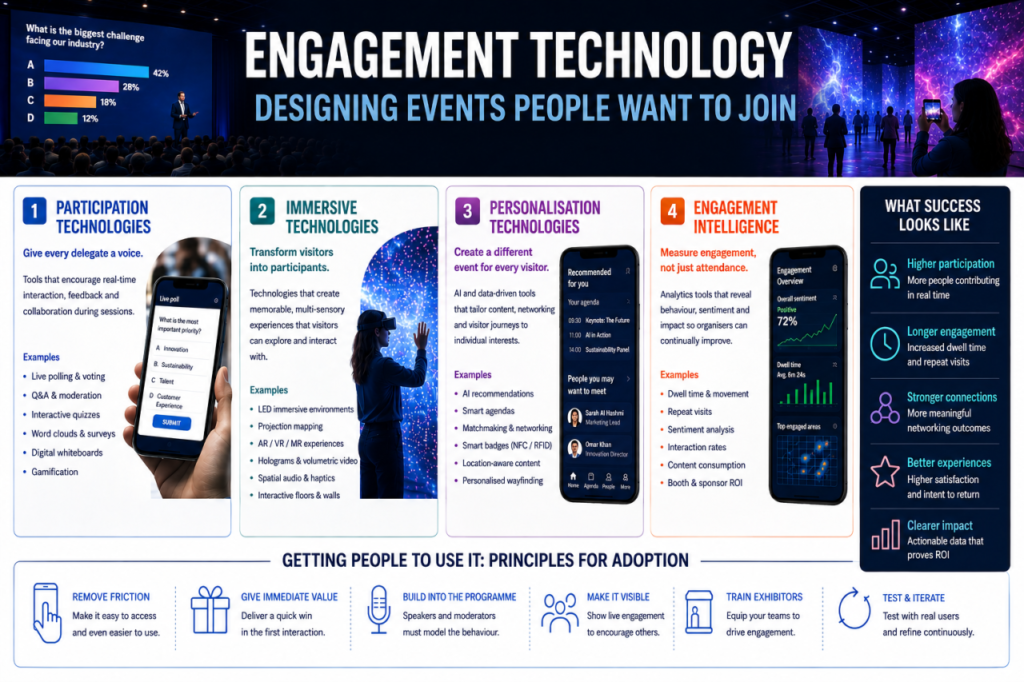
Immersive Technologies: Turning Visitors into Participants
Immersive technologies are transforming exhibitions and cultural events from places people visit into experiences they actively explore. Interactive LED environments, projection mapping, holographic displays, augmented and mixed reality, spatial audio and haptic technologies allow audiences to engage with content rather than simply observe it. At GITEX Global 2025, examples included holographic mesh LED, smart-glass mixed-media installations and motion-based VR simulation experiences. Companies such as Dubai-based Artnovi and Option 1 Events are demonstrating how immersive storytelling encourages longer dwell times, deeper emotional connections and greater social sharing. In many cases immersive enhancement creates an emotional connection to a simple story being told which engenders behaviour change, an ROI element that has become a key performance indicator for event success.
AI Is Creating a Different Event for Every Visitor
Artificial intelligence is becoming the invisible layer connecting the event experience. AI-powered recommendation engines personalise agendas, suggest networking opportunities and recommend exhibitors based on visitor interests and behaviour. For expos, AI networking platforms such as award-winning Grip being used by Dubai-based DMG Events analyses visitor data to deliver personalized networking, meeting recommendations and suggestions for stage content sessions via their AI powered match making function that enhances business outcomes.
Measuring Engagement and Measuring Impact
Attendance figures alone reveal very little about the quality of an event. Today’s organisers are increasingly measuring behavioural outcomes including engagement rates, audience sentiment, booth dwell time and movement patterns. Dallas-based Zenus provides anonymised insights into how visitors move through venues, interact with content, and measure their emotions as they visit exhibitor booths. At Dubai’s Coca-Cola Arena, they deployed AI enabled IoT sensors that passively captured aggregate foot traffic and dwell time during a multi-day technology summit. This approach validated engagement patterns and spatial layout efficiency without collecting any personally identifiable information.
Great Technology Amplifies Great Event Design
Technology should never become the attraction. The most successful events begin with a clear understanding of audience needs and overarching event objectives before selecting technologies. Even the most sophisticated AI, immersive environments or engagement platforms cannot compensate for poor content, uninspiring speakers or weak event design. Technology is most effective when it becomes almost invisible, quietly removing barriers and enabling richer human interaction.
The Biggest Challenge Is Technology Adoption
Many organisers invest significantly in engagement technology only to discover that attendees fail to use it. Successful adoption depends on understanding audiences, making participation effortless and immediately valuable. You need a clear engagement plan. The first interaction should be frictionless, delivering a clear benefit, whether through personalised agendas, AI networking or exclusive content. Speakers and moderators must actively encourage live participation, while exhibitors should invite visitors to interact rather than simply observe. Visible participation encourages others to join, turning engagement into a shared experience rather than an individual activity. But how do you design an Event Engagement Plan? Here is a simple EEP approach to consider.
The Event Engagement Plan
Let’s conclude this article with a Five Step Event Engagement Plan that aligns with overall event objectives:
1. Define Objectives & KPIs: establish what engagement needs to achieve and how success will be defined.
2. Design the Engagement Technology Stack: identify the right combination of technologies for an audience to support the event objectives and desired audience behaviours.
3. Build the Measurement Framework: determine how engagement data will be captured, integrated and connected to event KPIs and ROI.
4. Evaluate Engagement Outcomes: assess performance against agreed objectives to understand what generated meaningful audience engagement and value.
5. Optimise & Evolve: turn engagement intelligence into strategic recommendations that improve future event design, technology investment and audience outcomes.