

India is known for big fat weddings. Mine was no exception. We had a huge number of relatives, friends, and three photographers covering every angle. And yet, weeks after the wedding, the people struggling the most weren’t my wife and me. It was our relatives, desperately trying to get hold of their photos.
That problem stuck with me. The technology we built to solve it was genuinely novel at the time: a fast, simple way to distribute event photos to the people who needed them. Before long, we had an opportunity we hadn’t anticipated: an invitation to exhibit at GITEX Global, the world’s largest tech show.
Attendees at GITEX loved receiving their photos quickly. But the organisers came back with a different ask: could we make attendees share those photos on social media?
It sounds like a simple request. But it stopped me in my tracks, because I realised I’d heard that ask before, just in a different context. Before founding Premagic, I was a marketer. In my previous two roles, I built advocacy and marketing solutions for brands: getting people talking and creating organic reach through real voices. What GITEX was describing wasn’t just a product feature request. It was advocacy marketing. And we were sitting on the perfect mechanism to deliver it.
From that conversation, Premagic evolved from a photo distribution tool into a post-event advocacy marketing platform. We built for one clear goal: get attendees to share their own authentic event moments, and let that content do the marketing work.
As we opened up new geographies and worked with more organisers, the same pattern kept showing up: the more personalised the content, the more likely attendees were to share it. That insight pushed us toward building AI Avatars, personalised, stylised attendee content that felt genuinely theirs. The more personal it felt, the further it travelled.
We also started recognising that post-event was only part of the opportunity. Organisers were struggling to drive registrations. Pre-event marketing was expensive and often generic. And we already had the tools to solve it differently. We built personalised “I’m Attending” advocacy posters giving registered attendees something worth sharing with their own networks. Every attendee became a registration driver for the next person.
What started as a post-event tool had naturally grown into something bigger on its own terms. Pre-event to build buzz and drive registrations. During the event to capture and distribute moments in real time. Post-event to extend the experience well beyond closing day. A complete end-to-end event marketing platform that organisers can run as a campaign across every stage.
The test that proved the model: MEES 2025
The clearest proof of this evolution came at the Middle East Event Show 2025, run by Informa Connect.
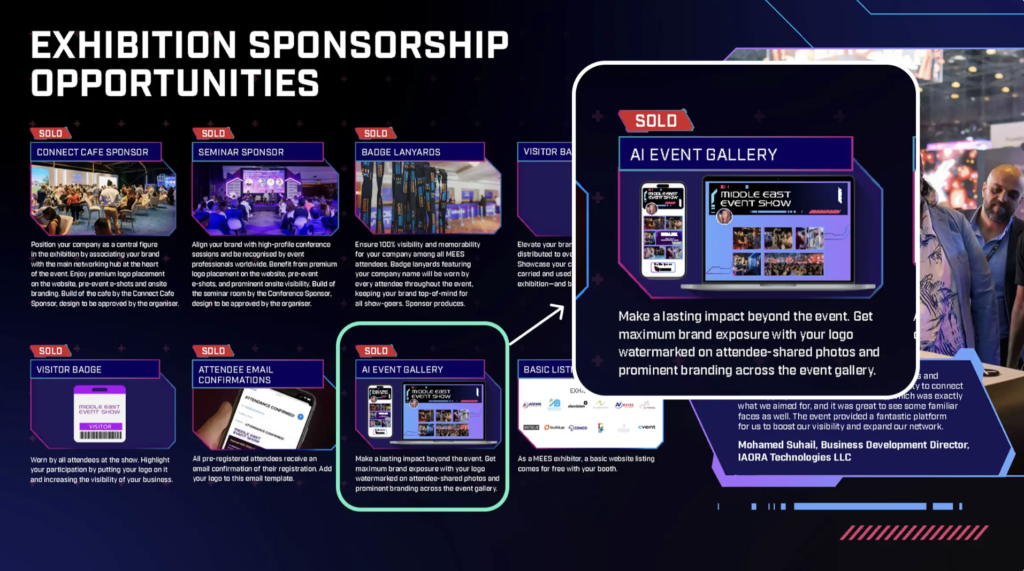
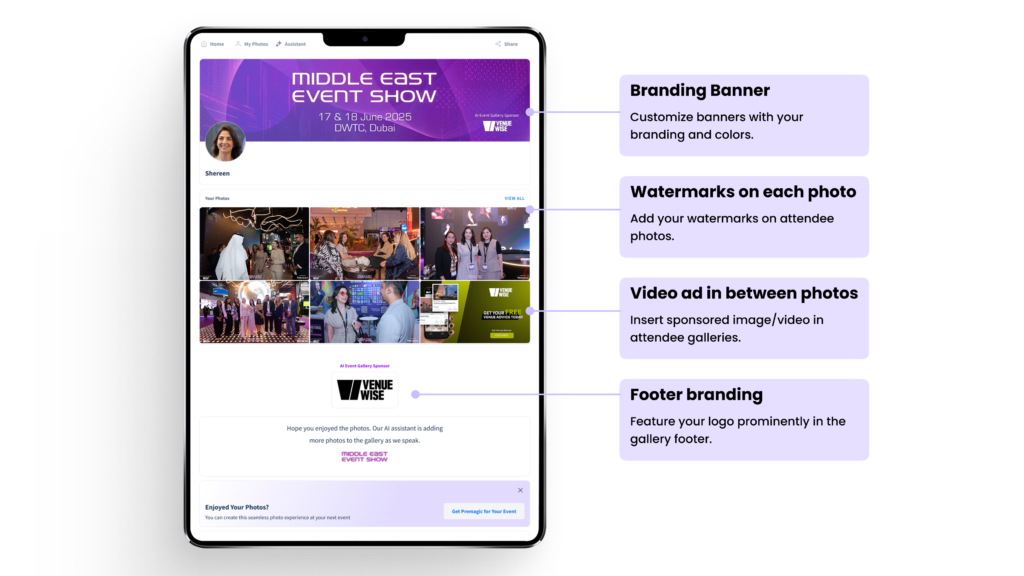
It started as a post-event opportunity. Photo distribution was placed on the sponsorship deck as a standard deliverable. A sponsor came on board, purchasing it as an AI Event Gallery package. Their branding was embedded into every attendee photo, placed in the gallery footer, and carried as a native video ad inside the gallery experience.
What happened next was the real story. Attendees didn’t just download the photos. They shared them. Branded content moved into their networks organically, with no paid push behind it. The sponsor got visibility that outlasted the event and travelled further than a banner ever could. Tens of thousands of branded photos distributed. Thousands of unique advocates pushing that content into their own networks.
The success at MEES 2025 led Informa to add the format to their standard sponsorship deck for future events, bringing Premagic into more of their shows. A repeatable commercial model that an organiser of Informa’s scale builds into their offering says more than any single metric.
MEES 2026: the full lifecycle
This year, we return to MEES with a bigger brief.
Rather than activating at a single stage, we’re running our tech across the full event lifecycle. Sponsor branding in pre-event “I’m Attending” content to drive registration buzz. Real-time distribution during the show as attendees capture and share moments. And the post-event gallery that proved itself in 2025. The same principle runs through all three phases: sponsor visibility inside content the attendee already wants to share, rather than placed around content they’re trying to ignore.
We’re also proud to be shortlisted as a finalist for Best Use of AI at an Event at the Middle East Event Awards 2026.
What the journey actually taught me
We didn’t plan any of this. We followed the questions event organisers were asking and built toward the answers. The wedding problem gave us the technology. GITEX gave us the marketing insight. MEES gave us the commercial proof.
The principle underneath it all is simple: find what attendees are already doing, and give organisers a way to attach real value to it. Build inside existing behaviour. Make it measurable. Keep following the signal.
That’s what Premagic is now. And we’re still building.